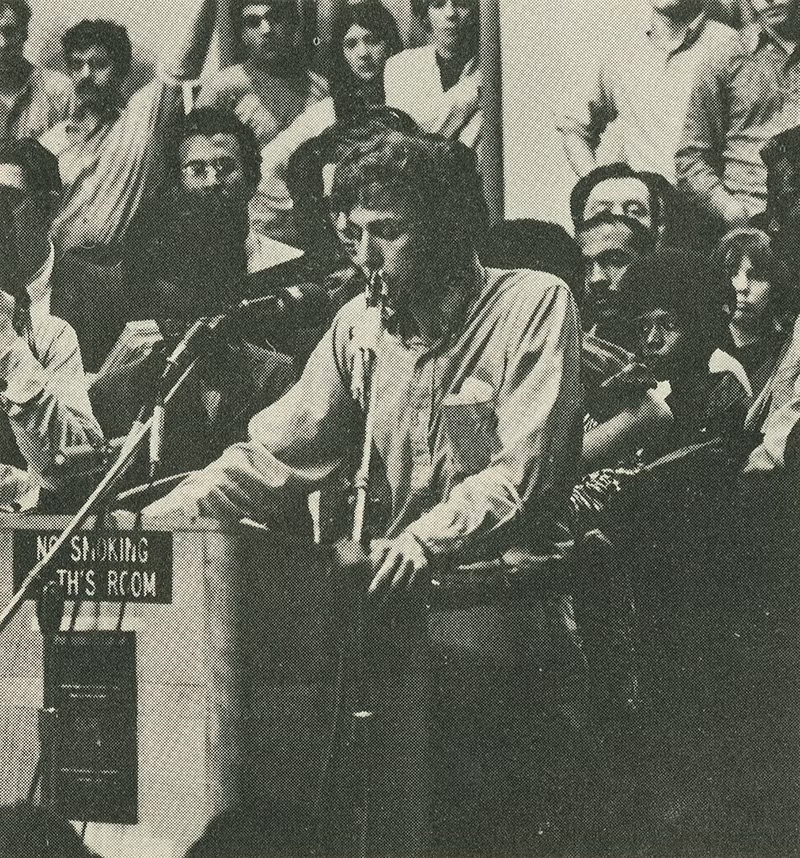
Penn’s historical complicity in state violence, the military industrial complex, and human rights violations is nothing if not steadfast. Two moments in this long history—as well as how students mobilized in them—are critical to understanding the role of activism at Penn: the antiwar, anti-Penntrification organizing of the sixties and the anti-apartheid activism of the eighties and nineties. These moments demonstrate both that Penn has always prioritized profit over people, and that students have the power to change that.
In the sixties, the student body’s frustration at the immorality of the Vietnam War was exacerbated by Penn’s direct involvement in chemical and biological warfare research. As young people faced conscription into a war of imperial violence against the Global South, the University established secret research partnerships with the Department of Defense.
Project Spicerack and Project Summit, which studied “crop-killing agents and man-disabling chemicals” like the infamous Agent Orange, were two of these projects. Penn alumni involved in student government and activism in the sixties recall being informed of the projects by a whistleblower from the Young Socialists, who noticed suspicious orders from the Institute for Cooperative Research as he worked in the Penn bookstore. The student alerted local anti-war activists and lost his job, kicking off a wave of protests, sit-ins, and student ultimatums.
In 1965, around 1200 students participated in an antiwar teach-in at Irvine Auditorium—in 1967, 82 students signed a “we won’t go” petition, expressing their refusal to acquiesce to the military draft. 400 more students signed on to support the petition. That year also marked one of the first antiwar sit-ins on Penn’s campus,, which took place in Logan (now Claudia Cohen) Hall when Dow Chemical held an on-campus recruitment event.
Students also mobilized against the University City Science Center — a site for research that contributed to the “redevelopment” (displacement) of West Philadelphia in 1969. In protesting Penn’s expansion into West Philadelphia without student and community input, students staged the longest and largest sit-in at Penn to this day. It ended after six days, when Penn Trustees accepted the students’ proposal that a commission be formed to include student and community voices and ensure that “University development would not conflict with community development.”
The protests’ interruption of “business as usual” led the University to consider how it might draw lines around acceptable behavior and student discipline. In 1967, a faculty committee was formed to evaluate student conduct on a case-by-case basis. After pushback, students who had to defend themselves were given the option to go to the Student Judiciary Committee instead of the FC. As a student representative on the FC recalled, students understandably opted to be heard by their peers on the SJC. In 1968, then-Carey Law School Dean Robert Mundheim led the formation of a new commission that evaluated open expression on campus. With the group’s recommendation, Penn created its Open Expression Guidelines. These would next be updated in 1993, amidst another key moment in the history of organizing at Penn: the anti-racist and anti-apartheid movement.
In 1985, the Black Student League staged a demonstration against a lecturer that “harassed” Black students, referred to them as “ex-slaves,” and asked them to cite reconstruction amendments from memory. The professor did not return the following semester, but Penn administrators also found that the students’ actions violated the University’s open expression guidelines.
In response to the 1985 demonstration, the then-President and then-Provost formed a committee to sharpen the guidelines’ language, but no actual changes to the standards were made until 1993. The late eighties and early nineties did, however, see other policies curtailing students’ right to free speech and protest. In 1992, for example, the University Council recommended Penn Police be allowed to photograph (and thus identify) students who violated guidelines.
In 1986, the Black Caucus at Penn—consisting of the Black Student League, Black Students Against Apartheid, and the Penn African Students Association—sent a letter to then-President Sheldon Hackney speaking out against the University’s financial ties to South Africa.
Penn and its trustees conducted business and owned stock in corporations operating in or aiding South Africa. This included companies such as Dart & Kraft, which violated the Sullivan Principles governing international commerce with South Africa. Moreover, First Pennsylvania, the primary bank overseeing the University’s finances, loaned money in 1980 to the Space Research Corporation, which sold military technology to apartheid South Africa despite an international arms embargo.
In between the Space Research Corporation incident in 1980 and the Caucus-Hackney letter in 1986, students and non-Penn affiliates alike had continued organizing against the University’s pecuniary ties to South Africa. The Penn Coalition for Divestment held a rally in 1982 outside of the Furness Building (now known as Fisher Library) that featured a photo exhibit of daily life for non-white South Africans under apartheid. In 1985, another rally, with over 250 students in attendance, was held outside a Trustees meeting. Most famously, April 1986 saw encampments on College Green, sit-ins in the President’s office, and a demonstration at the Trustees’ executive committee meeting. In 1987, Penn finally divested from business that profited off apartheid.
But the University’s support for apartheid is hardly over. Today, Penn labs develop technology for weapons that are used to displace and murder Palestinians, strengthen the Israeli regime, and commit active genocide in Gaza. Like Dow Chemical in the sixties, technofascist companies like Palantir continue to directly advertise to Penn students in the hopes of recruiting young people to make “American industry dominate” through its work for ICE, involvement in facilitating the Iran War, and role in the genocide in Gaza. Palantir sponsored the Penn computer science and engineering departments until 2021, when students across the nation pledged not to work with the company due to its collaboration with ICE.
The very open expression guidelines developed as a result of the sixties, eighties, and nineties’ student protests were utilized to quash dissent during the 2024 Palestine encampment on College Green. They are currently under revision, with the Penn administration extending their original deadline to hear further public feedback.
If history repeats itself, then it asks us the same questions over and over again. Will we sit idly by? Will we mobilize? How persistently? The organizing of past Penn student activists can instruct our answer.
The University’s bureaucracy has shifted and grown in the past few decades. If once, police photography of noncompliant students was described as a “last resort” measure, the University’s response to the 2024 encampment shows that student surveillance is a key tool for the administration today. The University no longer shows a willingness to publicly engage with pushes for divestment; while the trustees of the late eighties formulated a gradual divestment policy from South Africa (albeit after a protracted struggle by student activists), today’s Trustees are linked to founders of the Canary Mission. Today’s administration, through the words and actions of several task forces and commissions, has “consistently stated that it does not support divesting from, boycotting, or sanctioning Israel.”
Organizing at Penn now must adapt to a climate in which Penn’s administration seems increasingly less willing to engage with antiwar, anti-genocide, and anti-apartheid sentiment. Students may only get ahead if they are persistent and consistent in their demands. Cohesive networks of mobilization will be essential to organizing in the style of Students Against Apartheid in the eighties and Students for a Democratic Society in the sixties. Penn’s willingness to arrest and harm its students during a time when activists have become ICE targets means that organizers must truly put into practice the line: “we protect us.”
Despite changes in University bureaucracy, student population, and community relations, the activism of the past teaches us the importance of organizing through strong coalitions, staying persistent in demands, and taking collective action. While a Penn education may teach you to interpret the world, the point is always to change it.

