Billionaires, Blackmail, and the End of Academic Freedom.
by Anonymous, 2024, small update 2025
For most people, a donation is a charitable act. However, a large gift to a University such as Penn has a dual nature as both charity and investment. The charity finds praise for the donor’s generosity and perhaps their name on a building. The investment brings influence either through direct contact with the administration or a seat on the Board of Trustees. Those trustees run the University, while the faculty only have advisory power, the students pretend power, and the other staff do not receive mention. It is as much a conspiracy to say that the donors control Penn as it is to say shareholders control Google; it is simply how the system works.
Trustees are bound to act “in the best interest of the University,” which they, as wise billionaires, are obviously much better able to comprehend than the students and staff who inhabit it. This massive power does not come as a reward for the donors’ massive importance to the University. According to the financial report for the 2022-2023 fiscal year, Penn received 1.36 billion dollars from “tuition and fees” (money from students) and 1.33 billion dollars from “sponsored programs” (money from the government). Those same numbers show donor contributions amount to 239 million dollars, just 1.6% of all Penn income. Yet when undergraduates and graduates ask for just two seats alongside over 50 trustee members, the trustees respond that “the existing avenues of student representation” are sufficient. Like any group with power, donors do not like to share. The exercise of this power is supposed to be subtle, mainly through the appointments of administrators. However, last year a literature festival brought these normally hidden forces into the open.
Wall Street Executives don’t usually have much interest in literature, given its low rate of return, but this was no ordinary literature festival. Palestine Writes was hosting its annual conference at Penn, which set off alarm bells in Israel advocacy groups across campus and then the country. The ADL sent letters to Penn that the festival would “promote antisemitic narratives about Israel.” Speakers at the festival were accused of supporting antisemitism, terrorism, and ethnic cleansing of Jews. A group of billionaire trustees, who represent the most right wing and pro-Israel part of the American Jewish community, wrote a letter to the Penn administration (their employees) expressing “deep concern” about the festival. Palestine Writes, Penn’s Wrongs analyzes this hysteria in depth. While no single accusation could withstand one minute of google searches, their sheer number lent legitimacy to the situation and concealed the racism behind the backlash. The problem for the donors was not any individual speaker, but the expression of Palestinian culture itself. From the perspective of the pro-Israel donor base, Penn cannot in any way acknowledge the existence of the indigenous people of Palestine and their survival against colonial erasure. However, pesky constraints like “free speech” and “academic freedom” prevented Penn administration from just shutting down the conference. These would have to be overcome.
On October 10th, Marc Rowan wrote a letter claiming that “it took less than two weeks to go from the Palestine Writes literary festival on the University of Pennslyania’s campus to the barbaric slaughter and kidnapping of Israelis.” He attacked the administration for not condemning the literature festival and then issued a “call on all UPenn alumni and supporters who believe we are heading in the wrong direction to ‘close their checkbooks’ until President Magill and Chairman Bok resign.” While his lies couldn’t pass the editorial process of a student newspaper (the DP stated it “ had not currently verified all the claims” present in the letter), the administration had to take the threat seriously. Rowan is the Chairman of the Wharton Advisory board, a major donor, and a billionaire with many billionaire friends behind him. In the weeks following Palestine Writes Festival and October 7th, dozens of powerful donors had joined Rowan’s pledge. The choice was between Liz and the money, meaning the answer was never really in doubt.
What mistakes had President Magill made? She sent almost daily emails condemning antisemitism, sympathizing with worthy victims of Hamas terrorism, and properly ignoring all Israeli terrorism against the Palestinians (a policy which continues to this day). Chairman Scott Bok wrote in the DP, “What Rowan means by ‘heading in the wrong direction’ is unclear. But his later derisory references to ‘double standards,’ ‘pursuit of social justice,’ and ‘politically correct speech’ hint at a political agenda that far exceeds the mandate suggested by the words of that open letter.” Bok understood that the donor insurgency wanted radical change and they wanted to implement it themselves. That’s why they never made any demands of the administration; they just needed heads to roll.
Liz Magill needed to become an example, to show what happens to those who don’t follow orders. Because if a university president isn’t safe, no one is. The goal is a chilling effect on administrations and students at Penn and across higher education. As Rowan explained in an interview, “an outside force, trustees, needs to come in and help recenter some of these institutions … these kids who are marching, they don’t think about it because there’s no price to pay… one of the things we should do is make sure there’s a price to being an antisemite.”
Thankfully for Jewish students (like the author of this article) and unfortunately for Marc Rowan, there is no evidence of severe antisemitism at universities. While there have been a few occurrences documented at Penn, none have been connected to the Palestine solidarity movements. Rowan in the previously cited interview said that he “believes it [campus] is safe” and that his daughter never experienced antisemitism at Penn. However, this apparent paradox is resolved by the IHRA definition of antisemitism used and supported by the donor insurgency. This definition explicitly includes criticism of the state of Israel, such as “drawing comparisons of contemporary Israeli policy to that of the Nazis” or “claiming that the existence of a State of Israel is a racist endeavor.” The rising levels of anti-Zionism, as shown by the success of the student divestment referendum, gets defined as a crisis of antisemitism. This moves the issue from a political free speech battle to one of discrimination. The only issue is how to conceal that it’s not discrimination against a religious group, but against a genocidal state.
The United States Government proved highly willing accomplices for this task. It arms Israel and shields it from international consequences, so any criticism of the genocide reflects badly on them. The manufactured crisis of antisemitism allows them to turn criticism of our own leaders, which is protected speech, into an attack on a minority group. Additionally, many conservatives in Congress share the donors’ goal of taking over academia. They have complained for decades about bias against conservatives and in recent years against “critical race theory” and DEI that originates in the academy.
This culminated on December 5th, when Congress hauled President Magill and three other elite University presidents in to testify about “instances of vitriolic, hate-filled antisemitism.” During five hours of testimony, Magill helped produce the perfect propaganda moment — when Representative(R) Elise Stephanik asked how Penn would respond to calls for the genocide of Jews. Instead of pointing out that has never happened (which would threaten the narrative), Magill opted to say that the response would depend on the context, which, while legally correct, looked to many as a confirmation of the truth behind the hysteria. On December 9th, President Magill resigned and Chairman Bok left shortly after. The donor boycott had won their first victory. A few weeks later they would gain their second in toppling President Claudine Gay at Harvard. After showing what happens to those who oppose them, they set about consolidating their takeover.
On December 12th, Marc Rowan sent a four-page email to the Trustees which raised questions about the future of the University. The email questioned “the University’s policy on faculty and administrators promoting a particular viewpoint in their official capacity,” whether “any of the existing academic departments be closed,” and if Penn is “a neutral body that is a hosting entity for its community.” Any concern about antisemitism was now replaced with specific rules about free speech and academic freedom. Rowan in an interview described the role of the trustees: “they set strategy, they set tone, they set policy, and they pick a leader.” The same day as the email, the trustees selected their interim leader in Larry Jameson, who Rowan described as a “stable pair of hands.” The trustees think they have the right man for the job and can go about reshaping the University as they wish. In response to donor pressure, the University launched an onslaught against all opposing views.
In a reductio ad absurdum of the entire situation, the administration banned the screening of the film Israelism due to concerns about antisemitism. The film was made by Jews and shown by a Jewish campus organization, but donors can tolerate no attack on their favorite genocidal state. In response to doxxing and harassment campaigns against students and professors critical of Israel, the University routinely sided with the harassers, publicly condemning Professor Dwayne Booth for antisemitism (he made cartoons critical of Israel) and entangling protestors in webs of disciplinary action. In April, the University banned the student group Penn Against the Occupation. In the next months they suspended four students for protesting.
According to its website, Penn “cultivates leaders who serve.” The donors understand service means serving them; you can increase the value of their University and maybe even work at their companies, but never under any circumstance rock the boat. They want Penn to be perceived as “as a global leader in driving conversations about and promoting democratic values and institutions,” but to be internally totalitarian.
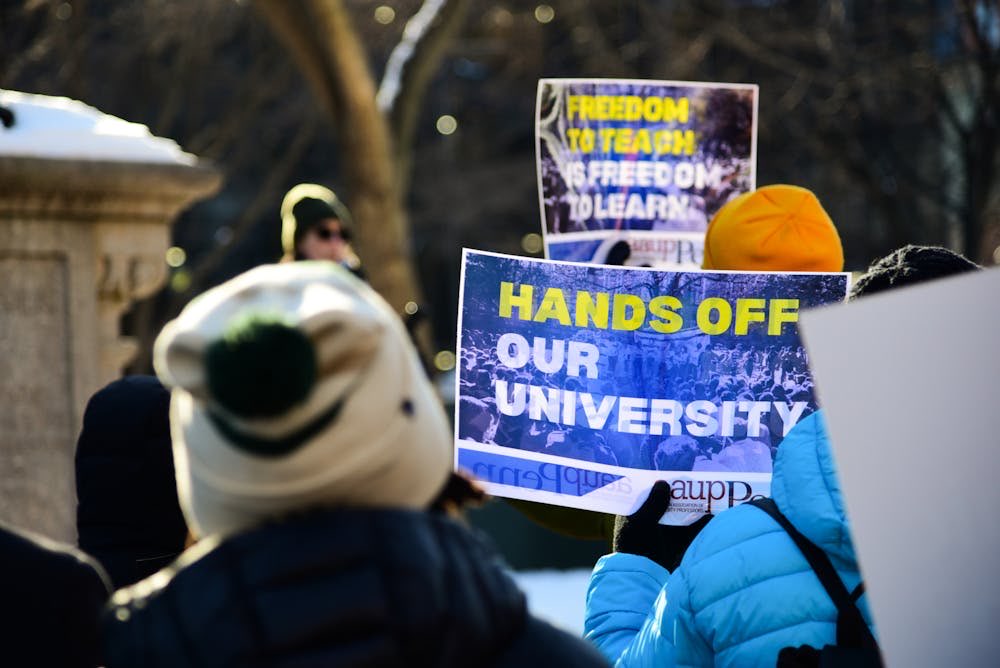
Many groups have resisted. In response to the film banning, the director of the Middle East Center resigned, while the department protested. The AAUP has consistently called out the University for their attack on academic freedom and even organized protests against it. They have made it clear the faculty will not take this assault without a fight, with their principled statements resisting the torrents of lies. Finally, students have organized to take back their University. RAs and graduate students have unionized. Students across the country created encampments in solidarity with the people of Palestine. They demanded that their voices be heard, that stop their tuition money and tax dollars from funding genocide. Our rulers want apathy, for us to study and party while they handle all the important questions. But they forget that they’re the outside force, that the University is nothing without its students, faculty, and staff. They might own Penn, but we are Penn.
 Penn Disorientation Guide