By Anon
When most people think of crime in popular culture and the media, it conjures up images of violent street crime. What is seldom mentioned is the brutal damage resulting from white-collar crime, corporate executives, and high-ranking government officials. White-collar and corporate crime, which includes fraud, counterfeit, extortion, insider trade, insurance fraud etc. is a severe detriment to society, responsible for an estimated $250 billion to $1 trillion in economic damages each year. The annual cost of street crime, in comparison, comes out to a mere $15 billion.
Despite these costs, it should come as no surprise that white-collar crime is seldom held accountable and is instead, glorified. Entities such as Palantir, Amazon, McKinsey, Morgan Stanley, Goldman Sachs, the CIA and many more all boast an extensive list of admitted crimes, however they are still presented to students as high-level, prestigious jobs that elite institutions, such as Penn, promote. Not only that, but these companies pay Penn for special access to its top students for recruitment purposes.
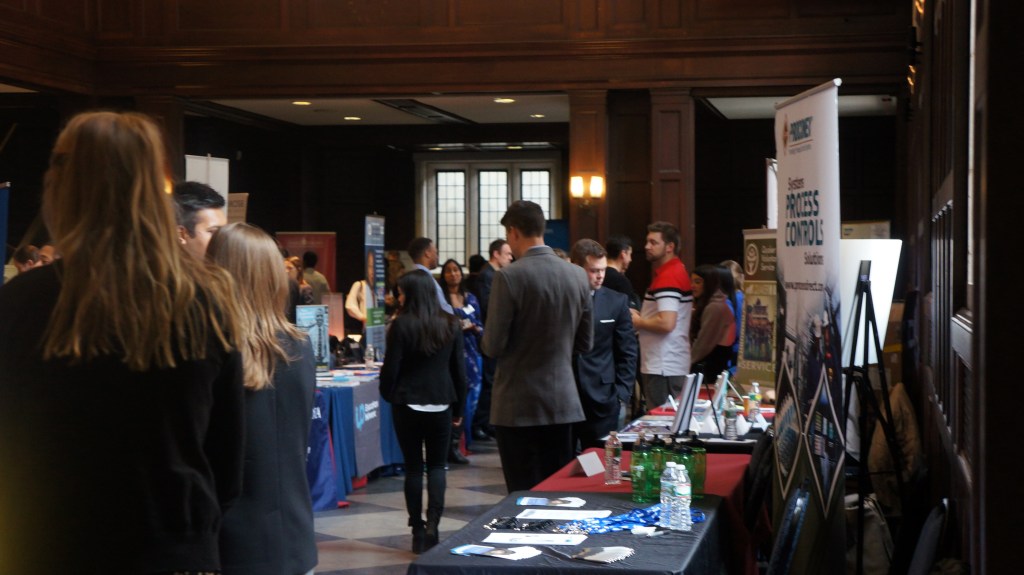
The fall is a recruiting season for companies at colleges, where the biggest companies will fork out millions of dollars to gain access to fresh talent on campus. The atmosphere is fiercely competitive, not only among recruiters with lucrative job offers and swag to lure people in, but also among students desperate for a prestigious job offer. What sticks out is the transparency that colleges, especially Penn, fails to provide in the contracts it has with companies and the insidious things these companies may be doing.
Let’s take Palantir for instance. Penn’s Career Services lists Palantir as a supporter, which has a $2000 annual cost. This gives Palantir special access to students via information fairs, faculty advisors, career fairs, and student profiles. When promoting Palantir, there is no mention of Palantir’s $38 million dollar contract with ICE or how Palantir has become ingrained into the military industrial complex, striking up billion dollar contracts with the military and profiting off oversea wars.
Other firms such as McKinsey, Deloitte and IBM are also guilty of striking up million dollar contracts with ICE, providing consulting services and tech support to aid with immigration enforcement. However, along with this, they are also guilty of crimes such as fraud, insider trading, and illegal trading of supercomputers to Russia. However, even when these corporations are found guilty, loopholes such as the deferred prosecution agreement, the non prosecution agreement and pleading guilty to a closed entity or defunct entity ensure that the corporation actually has nothing to lose. Essentially, these loopholes guarantee that corporations will receive a slap on the wrist, pay a small fine that is just a sliver of their annuals, and get off scot-free. The lack of accountability only ensures an endless cycle of crime once the news cycle has forgotten about the scandal in question. Corrupt corporate executives are rarely jailed and continue to exploit the working class while the United States continues to incarcerate black people at disproportionate rates. So why is that?
The United States is unable to punish the rich and powerful because of its own rhetoric used to discuss the rich and poor. The wealthy are an embodiment of the American Dream. They are characterized as hardworking, deserving individuals, while people of color and the poor are framed in a much different way. This is best exemplified in Ronald Reagan’s strategy to reframe the image of crime away from corporate crime and more towards a more punitive and racialized approach.
According to John Hagan, a sociologist who focuses on criminology, Reagan’s framing process “realigned the meanings of street crimes and suite crimes by vilifying the feared offenders of the streets and valorizing the newly freed entrepreneurs of the suites…”. Thus, Reagan pursued stricter drug policies by escalating the War on Drugs and operating on white anxieties surrounding the crack epidemic with a racial and “ fear-driven trajectory of mass incarceration focused on the drug abuse of young minority males”. Reagan’s model of deregulation was further abetted by “a reckless ‘too large to fail’ policy of corporate immunity providing a nearly fail-proof freedom” to institutions.
So, what does this mean? Today, as countless people protest the police, mass incarceration and push to redefine the definition of crime, they are met with skepticism and brutality. All the while, corporate crime continues to be a necessity in the capitalist system we function in. These companies promote their social missions to college students, who are completely unaware of the full impact of their actions. They take jobs with these companies, either unknowingly carrying out their work or hoping to change the system from the inside. Which begs the question, how is anyone supposed to instigate change if they’re all being funneled into a system that forces them to become complicit with their company’s crimes?
 Penn Disorientation Guide