The University has a fraught history with the exploitation and representation of Indigenous people
By Anon
In Pennsylvania, there are no federally recognized Indigenous tribes, even though more than 18,000 Native Americans live within the state. This sets the tone for understanding the University of Pennsylvania’s relationship with local Native communities and with Native students. It is a relationship mostly characterized by exploitation and a lack of visibility and representation.

Exploitation
The University of Pennsylvania is located on the ancestral homeland, Lenapehoking, of the Lenape Nation. Prior to colonization and into the current day, the Lenape people have lived throughout Eastern Pennsylvania, Delaware, Southern New York, and New Jersey. In the 1730’s European settlers decided to “reinterpret” a foundational treaty that was established between the Lenape and William Penn over land. The reimagining of the treaty led to the Penn family taking about 750,000 acres of Lenape land, further displacing Lenape communities. This land would become present-day Philadelphia.
Penn’s shrouded history with Native communities can be demonstrated in connection with the Penn Museum. The museum contains many cultural objects that were obtained without the permission of the Native tribe they originate from. The museum also houses the Morton Cranial Collection, a large collection of crania which were used by Perelman School of Medicine’s Samuel Morton to attempt to prove the supremacy of Europeans (See: Unethical research). In 2020, after student outcry against the possession of the collection, Penn Museum removed the skulls from public display. But, they are still available to students and faculty for research purposes.
Through the Native American Graves Protection and Repatriation Act (NAGPRA), some skulls and other human remains kept by the Penn Museum have been repatriated by Native organizations and tribes over the past few decades. However, due to the framing of NAGPRA–which only requires the return of a limited scope of human remains and cultural objects to federally recognized tribes and certain Native American/Alaska Native/Native Hawaiian organizations—many of the crania remain with the museum.
Another example of the Museum’s exploitation of Native people can be found within the employment of Tlingit Native, Louis Shotridge. From 1912 to 1932 he unethically gathered more than 600 items from his own communities and other tribal communities for the Museum. Members of those tribes today say that Shotridge had no right to obtain those objects on behalf of the Museum and have made claims under NAGPRA to get them back, with varying degrees of success. Items that have not been repatriated are still held by Penn Museum.
Many of the cultural objects and remains that have ended up with the Penn Museum came from donations. It would serve well in the future for the museum to be proactive by looking further into the donations they receive before making them part of the museum and by seeking repatriation efforts without being prompted by outside outcry.
Representation and Invisibility
If you were to research Native American history within UPenn, you would come across several proud references to 5 Native Americans: Jonathan Gayienquitioga, Philip Gayienquitioga, John Montour, Robert Daniel Ross, and Elizabeth Weston, all early attendees of the university. Little to no information about them can be found online or in university archives. When they attended Penn there was no community for them and few opportunities to study culturally relevant topics. There are many students at Penn today who have no idea that there are Native students on campus. Some of those students don’t know that Indigenous people still exist at all. There is no designated space for Native students within Arch on Locust Walk, but plans for the inclusion of NAP within ARCH have been in the works since joining 7B.
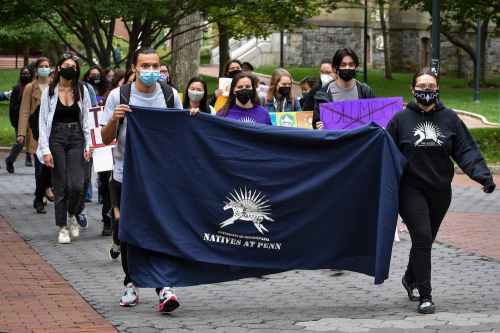
For those that are aware of Indigenous students on campus, their legacy at Penn has been hard fought. For the past 30 years, the population of Indigenous students has very slowly and gradually increased, and with it community and support. But the community building and support haven’t come from the university, it has come from the labor of students and staff willing to take on an extra role with no extra pay. Natives at Penn, the only undergraduate group dedicated to Native students, was established in 1993 to help students who were feeling isolated and unseen. They started contacting other schools with programming for Native students, demanding Admissions increase recruitment efforts, trying to address retention of Native students, all while doing classes, working jobs, planning powwow, and supporting one another mentally and emotionally.
Unfortunately, the same issues from 1993 and before still plague Native students at UPenn although some strides have been made. In recent years, NAP has fought for those same issues: recruitment, retention, class offerings, structural support, and more. For two years NAP petitioned for the inclusion of Indigenous Peoples’ Day on the academic calendar and it has just been added this summer. Tina Pierce Fragoso, Lenape, worked for admissions as the coordinator for Native American recruitment, and since her years in that position, annual Native enrollment has tripled.
Call to action
Many of the cultural objects and remains that have ended up with the Penn Museum came from donations. It would serve well in the future for the museum to be proactive by looking further into the donations they receive before making them part of the museum and by seeking repatriation efforts without being prompted by outside outcry. As Natives at Penn expands, and the voice of Native students is heard, NAP has published their demands of Penn: a paid, full-time staff member to support NAP – Toyce Holmes, FGLI Program Coordinator, graciously volunteers her time the current advisor to the group – efforts to increase the recruitment and retention of Native students, faculty, staff, and administrators, and a dedicated and adequate space for Native students on campus. You can also support the Native community at Penn by attending and uplifting NAP’s cultural events and annual powwow, which also bring a measure of recognition and support to Lenape community members.
PILOTs | Table of Contents | Penn and Isreal
 Penn Disorientation Guide