Penn routinely devalues and harms its First-Generation and/or Low-Income (FGLI) students by providing inadequate resources or no support at all. This harm relates to the culture of capital wealth and elitism at Penn, and the limited programs for extensive financial or interpersonal support present at Penn.
by Anonymous
Penn offers nearly 46% of undergraduates grant-based financial aid, with some of those students falling into the category of First-Generation and/or Low-Income (FGLI). Student Registration and Financial Services (SRFS) emphasizes on their website that students from families that make between $65,500 and $140,000 receive full tuition coverage and those who make less than $65,500 are offered packages that cover the entire cost of attendance. First-Generation and/or Low-Income (FGLI) students make up just 15% of Penn students across the Class of 2024 and 2025. Additionally, SRFS classifies approximately 950 students as “highly aided” as of 2018.
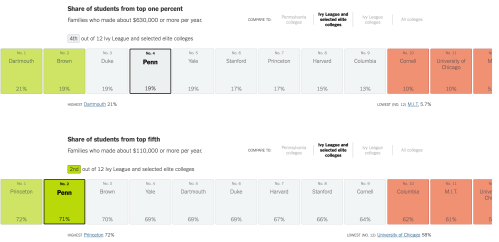
Despite receiving varying degrees of financial aid, many FGLI students still struggle with their economic circumstances at Penn. Only 3.3% of students at Penn are from America’s bottom 20% of family income, while 71% are from the top 20% and 19% are from the top 1%. As a result, low-income students can feel extremely isolated. A low-income student can feel out of place in various ways during their undergraduate experience, whether through inaccessible fraternity/sorority dues or social events, unrelatable summer or break plans, or general feelings of inadequacy compared to richer peers.

These feelings of alienation that impact FGLI students are usually referred to as “imposter syndrome.” According to Penn’s Career Services, imposter syndrome is when “ you don’t feel you belong in a context or perhaps you perpetually feel underqualified.” With many FGLI students coming from secondary schools with far fewer resources than Penn and experiencing unique financial struggles while in college, we often feel like we do not fit in with those who are from a higher income bracket. While we understand that a Penn education is a rare opportunity and are thankful for it, we still believe that the university does not provide enough support for FGLI students, especially in dealing with the psychological consequences of imposter syndrome.
Penn does offer some valuable resources for its FGLI students, which you can find listed at the end of the article. This being said, Penn holds an endowment valued at more than $20 billion, yet the university only provides FGLI students with the absolute bare minimum. One example of this is the summer funding program for highly aided students. Highly aided students are eligible for $4500 worth of funding to supplement underpaid and unpaid summer internships. Many Penn students opt to stay in Philadelphia to complete internships at various organizations and companies, where the average rent for a studio apartment is around $1,200 per month in Philadelphia. After rent, these students have just $900 for food, transportation, and other necessities, leaving little to no funds for personal use or savings.
While Penn’s endowment continues to grow (up 41.1% in the most recent fiscal year of 2021), students are facing higher and higher costs for a college education. Penn can do more. They should diversify the socioeconomic status of their student body by encouraging more FGLI students to apply and accepting more of them. This can be done by making tuition and housing free for every FGLI student. QuestBridge, a program that connects low-income students to its partner universities, already has a partnership with Penn that covers tuition, housing, transportation, books, and some personal expenses for all QuestBridge students. With its massive endowment, Penn is financially capable of extending these benefits to all low-income students.
Additionally, Penn should extend dining hall hours. Staying up late after midnight, whether it is studying, partying, socializing, or at employment, is common practice at Penn, but the latest dining halls close around 10 PM on weekdays and 8 PM on weekends. This usually means an extra unpaid meal for FGLI students, for whom eating takeout every night further stresses our spending budgets. With careful consideration of FGLI concerns, many other feasible accommodations are sure to come to the forefront.
Resources for FGLI Students
- Masterlist from Vice Provost for University Life: https://home.vpul.upenn.edu/fgli/
- General FGLI Services: https://home.vpul.upenn.edu/fgli_books/
- Highly-Aided Students: https://srfs.upenn.edu/financial-aid/highly-aided
- FGLI Organizations on Campus: https://gicatpenn.weebly.com/fgli-orgs.html
- Emergency Funding: https://srfs.upenn.edu/financial-aid/emergency-funding
- Career Services for FGLI Students: https://careerservices.upenn.edu/channels/first-generation-and-low-income-students/
- Work-Study Information: https://srfs.upenn.edu/financial-aid/work-study
 Penn Disorientation Guide