By Anon
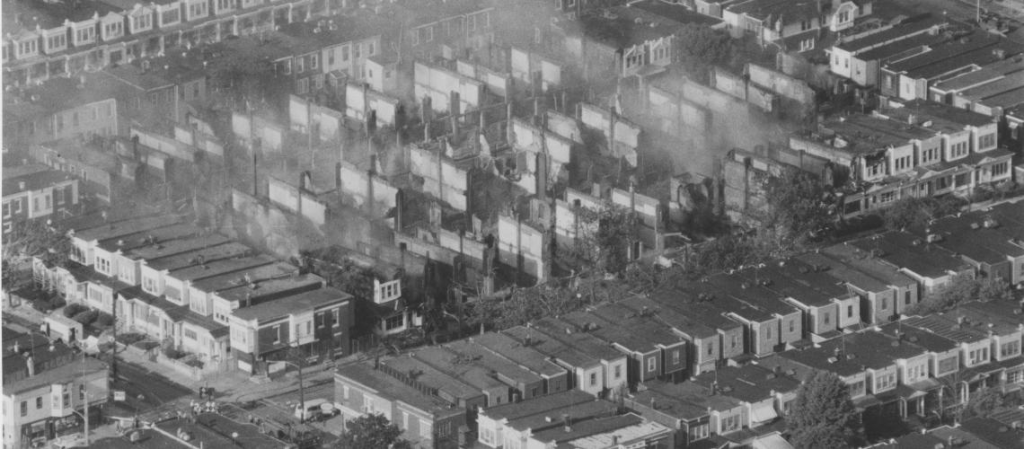
May 13, 2020, a day amidst growing Black Lives Matter uprisings across the country, was the 35th anniversary of the MOVE bombing. 35 years ago, the Philadelphia government, under Mayor Wilson Goode and Police Commissioner Sambor, used military explosives over MOVE’s headquarters in Cobbs Creek, West Philadelphia. The bomb and resulting fire killed 11 MOVE members, including five children, and destroyed over 60 homes. The MOVE bombing and aftermath are a result of systemic racism and institutional silencing of Black radical voices. Though frequently overlooked, this day illustrates police violence and institutional oppression at their paroxysm – and played out just twenty blocks from Penn’s campus.
MOVE is a revolutionary religious group based in Philadelphia which has roots in Black liberation and environmentalism. It was founded by John Africa in 1972 and considers itself a family, with all members adopting the surname Africa. MOVE was politically active from the outset, demonstrating against police brutality and animal cruelty. Their revolutionary and pro-Black ideology caught the attention of the notoriously racist and conservative Police Commissioner Frank Rizzo, who started harassing, threatening, and brutalizing the group with the power of the police behind him. Surveillance and police brutality at the hands of the city cemented MOVE’s belief in militant self-defense.
The first large confrontation between MOVE and the police occurred after MOVE members refused to vacate their compound in Powelton Village following a court order, supposedly for building code violations. Philadelphia police had blockaded the residence for 56 days; a steel fence was erected, their water supply was cut off, and forbade food from entering the compound. On August 8, 1978, Rizzo sent in hundreds of officers to force them out and bradished water cannons at them. Shots were fired and one police officer, James Ramp, died. Despite no forensic evidence linking MOVE and their weapons to the killing, 9 MOVE members were convicted collectively for that single bullet, and each one was sentenced to 30 to 100 years in prison. Two of them died in prison, and the remaining seven were released after around 40 years of imprisonment each, subject to the abuse of the carceral system. Delbert Africa recently passed away months after gaining his release.

Their Powelton Village Residence was torn down after the confrontation (and before any credible investigation of the confrontation scene), and MOVE relocated to 6221 Osage Avenue in West Philadelphia. MOVE turned to fighting for the release of the MOVE 9. Neighbors became frustrated with the noise of blaring loudspeakers and “obscene” speeches, and sought reprieve from the city government. In response, the city evacuated the block and again shut off water and electricity to force MOVE members out. With no surrender from MOVE members, officers threw tear gas canisters at the house and the gunfire ensued. Commissioner Sambor ordered the compound to be bombed, ostensibly to remove the bunker on the compound’s roof. The bomb started a fire that was left to burn for over an hour and eventually engulfed the entire block. The only adult survivor, Ramona Africa, said that the police shot at MOVE members who tried to escape the fire. Once the fire abated, 11 MOVE members (6 adults and 5 children) died in the fire and an entire city block was burned to the ground. Ramona Africa was the only person ever charged with anything from the bombing; she spent seven years in prison for riot charges. Philadelphia was held liable for the bombing 11 years later in a civil suit.
Although they happened decades ago, the MOVE confrontations and aftermath demonstrate an ever-present pattern where state officials and officers use the criminal justice and carceral systems to silence radical voices and action while protecting the city from accountability. The city’s actions during the BLM uprisings mirror the tactics used against MOVE: brutal and militarized response to dissent, tear gassing residential neighborhoods, using arrests and charges to intimidate activists, lying to paint their actions as justified, and apologies that come way too late with no accompanying transformation. The main difference is that today, there are too many people fighting back to imprison them all. While the MOVE 9 are free and the burned rowhomes rebuilt, the systems that killed and silenced those seeking justice are still in effect. The history of MOVE and its confrontations with the local government show how, today, we can understand the city’s response to the BLM uprising and how we can resist their attempts at suppressing radical change.
For more information:
Let The Fire Burn – Documentary on MOVE and the 1985 bombing directed by Jason Osder.
A Siege. A bomb. 48 dogs and the Black commune that would not surrender
Philadelphia bombing 1985 MOVE
Penn and the Climate Crisis | Table of Contents | White Collar Crime
 Penn Disorientation Guide