by the 2024 Penn Disorientation Editors
Welcome, dear reader, to the University of Pennsylvania. You are now a student at a highly acclaimed, historic, elite academic institution – an institution with a 21 billion dollar endowment, connections to influential and powerful people, and a reputation for intellectual excellence. Maybe you’ve strolled down Locust Walk, marveled at the beautiful architecture, heard stories of brilliant, successful Penn alumni, or scrolled through the seemingly endless opportunities now open to you. You’re free to study anything, from astrophysics to art to economics – and your professors will be the best and brightest in their fields. You’re free to explore cutting-edge research, start your own company, or travel all around the world. Penn is the very picture of knowledge, power, and wealth. But who, exactly, does all that power and wealth belong to? What will your classes teach you – and what won’t they? How free are you, really? Who owns Penn? Because it certainly isn’t you.
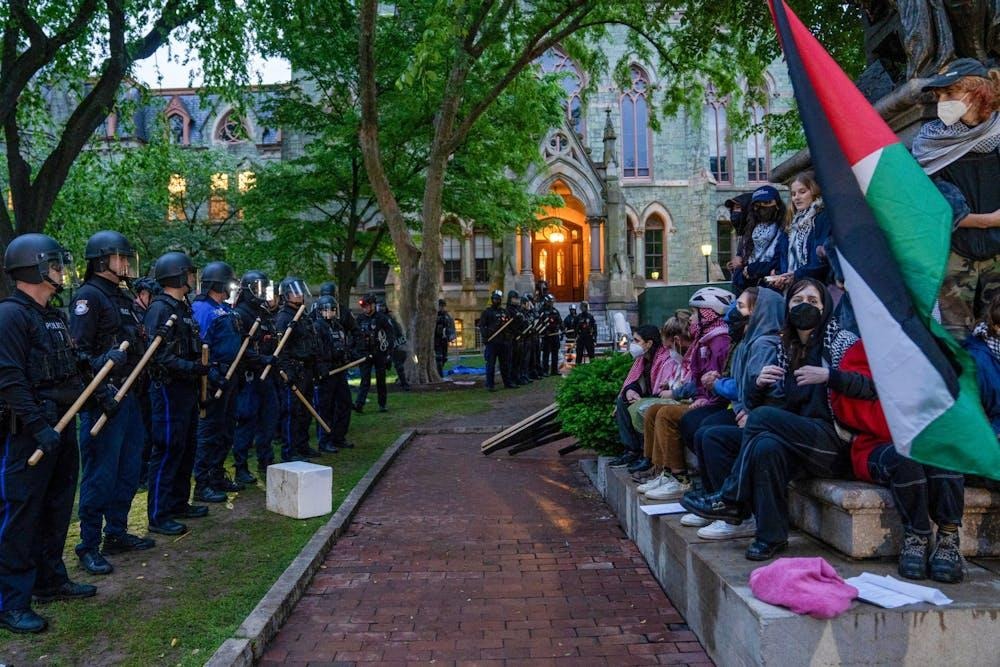
In the last year alone, this university has threatened, arrested, and injured students and community members, allowing Penn Police and the Philadelphia Police Department to brutalize and dehumanize protestors. Penn administration ignored its own Open Expression Guidelines to suppress and silence political speech, disciplined students for arbitrary and vague reasons, made empty threats and false accusations, and denied students entry to their own graduation despite promising otherwise. Penn has actively supported the ongoing genocide in Palestine, denied the reality of that genocide, and silenced anyone attempting to call attention to it. Penn failed to support students experiencing doxxing and harassment, offering minimal guidance only after repeated requests for aid. Penn is largely responsible for the gentrification of West Philadelphia and the displacement of its residents. Penn is complicit in the climate crisis, investing our tuition money into fossil fuel companies, allowing fossil fuel companies to fund and influence climate and energy research, and engaging in corporate greenwashing. Penn refuses to be transparent about where it invests its endowment, leaving students with no clue where our tuition money goes – and no say in how it’s spent. Penn has done everything in its power to suppress the basic rights of student workers to form a union and demand fair compensation. To top it all off, Penn’s most recent response to these peaceful endeavors for change was to impose new militaristic regulations that enable even stricter repression of speech and action.
This might seem surprising, coming from a university that is supposedly dedicated to “seeking dialogue and collaboration across differences,” teaching students to “think critically and lead effectively,” and “sparking revolutionary ideas”. But when we consider where true power lies at Penn, the reason the University fails to uphold its espoused values is obvious. Penn’s trustees, who hold ultimate power over Penn’s 21 billion dollar endowment, are also high-ranking executives at companies like Blackstone, Wells Fargo, J.P Morgan, and Goldman Sachs. Wealthy and influential Penn donors have publicly called for the suppression of student voices, and threatened to “close their checkbooks” unless Penn capitulates to their wishes. Penn has close ties to Zionists and pro-Israel groups, the fossil fuel industry, and the carceral system. Is it really so surprising that a university so deeply entangled with militaristic, corporate, and elitist interests acts to protect those interests instead of its students and faculty? Penn might tout itself as a freethinking, benevolent university committed to enlightening young minds and serving the community – but in reality, Penn is just an extension of the oppressive, profit-driven, individualistic system from which it derives its power. The events of last year were only a continuation of Penn’s long history of serving the wealthy and powerful at the expense of the students, faculty, and community the University claims to care about.
But as long as Penn has been oppressing its students, we’ve been fighting against it, through our words and actions, through our refusal to be dehumanized and shoved aside, and above all through our determination to educate ourselves on the truth – after all, aren’t we here to learn? To think critically? To challenge the ideas, beliefs, and systems that we exist within?
The Disorientation Guide is an annual publication that aims to tell the real story of the University of Pennsylvania – one that includes its long legacy of corruption, injustice, and oppression. Our first issue was published in 1972, and it criticized Penn for institutional racism and sexism, a lack of endowment transparency, complicity in the Vietnam War, and the gentrification of West Philadelphia – topics eerily familiar to student activists today. Both then and now, this guide was written to help Penn students disorient themselves from the false narrative of Penn as a place of learning, and reorient themselves to the reality of Penn as an institution driven by profit. The first step in challenging the abuse of power and the systems that enable that abuse is to recognize them for what they are. As Penn students, we have a responsibility to acknowledge our role in our university’s impact on Philadelphia and the world, the harms that are being perpetuated by our tuition money, the true cost of our education. But because we are Penn students, we have power within this university – we fill its classes, work campus jobs, run student organizations, and create a culture and community. A school cannot function without its students, and Penn is no exception. Individually, its easy to feel impotent in the face of wealthy trustees, corrupt administration, and a fundamentally inequitable system – but collectively, our power is more than enough to challenge theirs. So when we act together and refuse to be silenced, we can leverage our power to demand change, to demand our university live up to its own values and act ethically in its relationship with students, faculty, the Philadelphia community, and the world.
So, do you want to know where real power lies at Penn? To understand how those in power abuse it? To learn everything your classes won’t teach you about this institution? To become aware of the oppressive and unjust systems you exist within – and learn how to fight them? To find out who really owns Penn? All you have to do is keep reading.
 Penn Disorientation Guide