Black, Indigenous, and other students of color have advocated for cultural houses for decades. Penn administration has stalled plans to establish cultural houses, with adequate space and support, for just as long as students have organized themselves.
By Divulge Alliance at Penn
Introduction
For those who are not already aware, the University of Pennsylvania is a predominantly-white institution. Like all others, Penn has historically catered to more affluent white people, often leaving behind those who do not fit the category. This detail is overlooked by some who are aware of Penn’s strong history of establishing some of the nation’s first Cultural Resource Centers (CRCs) on college campuses. However, many remain unaware of the history behind these spaces and the war that their student leaders have continuously waged in their journey to advocate for students of color at this institutions.
Penn Women’s Center and LGBT Resource Center
This history would be incomplete without mention of the Penn’s Women’s Center (PWC) and the LGBT Resource Center. In April 1973, protestors occupied College Hall for four days in response to intense on-campus rape culture. Their sit-in prompted the founding of the PWC. The LGBT center was created in 1982 following violent homophobic attacks on campus. The original support group was led by founding director Bob Schoenberg (with assistance from work study students) and was located in Houston Hall. In 2000, following a large donation by alumni David Goodhand and Vincent Griski, President Rodin announced the full renovation of the 1870s Carriage House to expand the program, thus establishing the nation’s second oldest LGBTQ+ resource center.
Greenfield Intercultural Center
The Greenfield Intercultural Center (GIC) officially opened in 1984, following years of development as well as support from the Albert M. Greenfield Foundation. The then-Chair of the United Minorities Council (UMC), Jin Sung Pak, promised that the center would not go underused, and the founding director, Rene Gonzalez, quickly began working on programs to support minority students at Penn and combat institutionalized racism at the university. Besides GIC, the main cultural houses are Makuu (the Black resource center), the Pan-Asian American Culture House (PAACH), and La Casa Latina. These cultural houses started within the GIC, until their services expanded and the need for specialized spaces became unavoidable.
The Creation of the ARCH centers
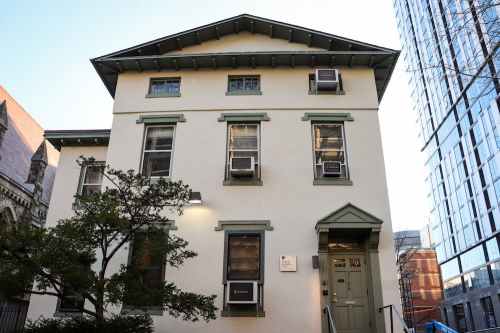
While university records detail the founding directors of the ARCH centers it is important to note the other figures who played a key role in organizing these centers’ programs. These figures primarily included GIC staff members, such as Karlene Burrell-Mcrae who was Associate Director at GIC before her full transition to Director of Maaku in 2001. Additionally, GIC leadership proposed an increase in funding to hire two full-time coordinators for the AAPI and Latinx students, and VPUL granted the increase.
For AAPI students, this coordinator was Yen Ling Shek (hired in 2000), who was encouraged to apply for her position by GIC Director Valerie De Cruz. Splitting her time between GIC and the then-forming PAACH similarly to the other GIC staff members, Yen Ling worked with student leaders to establish programs such as the PEER mentorship program and the Asian Pacific American Leadership Initiative. Her counterpart at La Casa Latina is Rubi Pacheco-Rivera, who was hired in 1999, when Latinx students were boycotting GIC to get their own space. They became the first of the three CRCs located in ARCH. Her work led to the creation of much of La Casa’s foundation, including many Latinx Heritage Month events hosted on-campus.
Also in 1999, members of the Asian American Student Coalition (APSC), including their chair Eric Lee, rallied on the College Green in an event they called “SPEAKOUT!” Their goal was to push for a devoted resource center for Asian American students, and it worked. Following the student protests, Penn’s administration decided to move forward with creating cultural houses for Asian American students on-campus. Their new home was to be ARCH (the Arts, Research, and Culture House), and the first recorded directors of the three cultural houses were Ajay Nair (PAACH), Anamaria Cobo (La Casa Latina), and Karlene Burrell-Mcrae (Makuu).
ARCH centers architect removal (125 words)
The University of Pennsylvania selected Dagit Saylor, a Philadelphia architecture firm, to prepare a feasibility study and schematic drawings for the ARCH. Due in no small part to ARCH’S status as historically protected, many of the renovations were abandoned. The CRCS were eventually moved to their current place in the basement, with the rest of the building being occupied by other departments and staff members. Former student leaders disagreed with the decision.

Fast-forward: the fight for more space (250 words)
In November 2019, Penn’s former president Amy Guttman offered to allow the centers to expand into ARCH, putting the decision into the hands of the student leaders. Rather than it being given back as repayment for what was taken away initially, it was presented as an administrative gift that students had yet to take advantage of. The deal itself failed to fully meet student needs and desires which included giving each center its own building. Further, the leaders of the Penn Association for Gender Equity (PAGE) wished for fraternities to be removed from their houses on-campus, which could create space for the CRCs to expand. Thus, the student leaders at the time rejected this offer.
Student body division and the growth of “7B” (125 words)
The aforementioned student leaders led the very same groups that protested to create the three cultural houses to begin with. While their history is more complex than what can be covered in this article, their activism over the decades has paved the way for marginalized students, and their alumni are responsible for the strides the centers have made during the past twenty years. Together, these umbrella groups are meant to oversee the aforementioned student affairs on campus, advocate to administration, and support their constituent organizations.
They were originally made up of UMC, UMOJA, the Latinx Coalition, and the APSC. As time passed, the Lambda Alliance (associated with the LGBT Resource Center) and PAGE (associated with the PWC) joined as well, forming 6B. It was in December 2021 when Natives At Penn (NAP) was officially added to the ranks after formally being constituents of UMC. Today, these leaders are known as the Seven Boards, or 7B. It is worth noting that the abbreviation “3B” may be used when referring to the groups directly related to the ARCH CRCs (before December 2021) and “4B” is used in reference to these groups post-December 2021, when NAP joined 7B. The leaders of “4B” are leading the conversation on CRC expansion.
The Spring 2022 town hall and the aftermath
In March 2022, NAP, APSC, UMOJA, and the Latinx Coalition (4B) hosted a town hall which the Daily Pennsylvanian wrote about in March 2022. The leaders of 4B pitched the acceptance of a VPUL-ARCH renovation deal, given that they met student needs in the process. There was some doubt in the crowd about whether this would be possible, but in the end, the general consensus was that more space is needed and that the proposal would be a start. Unfortunately, our doubts were realized.
In this meeting with 7B, Penn’s administration responded in a manner that, in students’ eyes, left little room for their opinions. While this information has not been formally publicized as of the date this article was written, CURF has already begun migrating out of its upstairs offices and space is being reallocated among the ARCH CRCs and 7B groups. However, nothing, including any necessary renovations, has been officially decided — partially because of ongoing changes in university leadership (e.g. the incoming President and interim Provost).
Closing
In summary, while there have been many wins in terms of support for communities of color at Penn, some promises were altered or broken across the past five decades. The plans to renovate ARCH to support 4B have been stalled for years, and even now, with NAP in the loop, no concrete plans have been set. The three main cultural houses are no closer to establishing their own spaces (like GIC and the LGBT Resource Center), due in no small part to their lack of significant alumni donations. The fight for cultural spaces for disenfranchised voices and groups still continues, despite claims otherwise. Lack of knowledge and acknowledgment of student groups, for whom cultural houses are significant, remain the largest barrier.
Resources:
- https://gic.vpul.upenn.edu/about/#history
- https://almanac.upenn.edu/search/results?q=cultural+resource+center
- https://almanac.upenn.edu/search/results?q=Greenfield+intercultural+center
- https://www.thedp.com/article/2000/09/paachs_last_chance
- https://www.thedp.com/article/2011/11/groups_plan_for_arch_renovation
- https://www.thedp.com/article/2019/02/penn-diversity-minority-cultural-group-arch-basement-space
- https://www.thedp.com/article/2019/11/penn-cultural-houses-arch-basement-curf
- https://www.thedp.com/article/2019/11/penn-renovations-arch-furniture-6b-cultural-houses
- https://www.thedp.com/article/2021/10/penn-6b-leaders-cultural-centers-fall-2021
- https://www.thedp.com/article/2022/03/penn-7b-town-hall-arch-cultural-resource-centers-space-locust
Asian American Studies | Table of Contents | Cultural Houses
 Penn Disorientation Guide