by Anonymous.
This summer, Penn’s administration moved to silence the voice of people without institutional power and backing, the voices of regular people who want change.
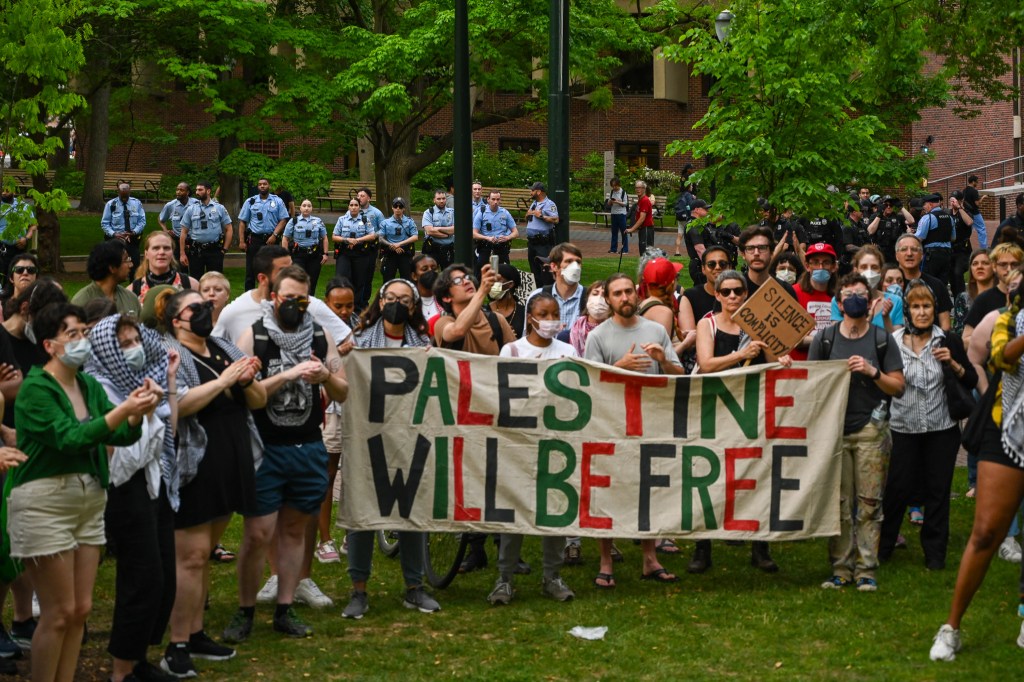
Their new open expression guidelines cracked down on pro-Palestinian protesters. Last year, Penn student protesters chalked Locust Walk, projected light-signs on buildings, chanted with bullhorns and instruments, held a sit-in, held a silent study-in, and encamped on University grounds (which has been done before without a ban). In an unmistakable pattern, these are now banned, banned, banned, banned, banned, and banned.
For everything they could not outright ban, they imposed sweeping surveillance and oversight. All events or demonstrations (indoor or outdoor) must be scheduled and approved, at least, a neat 48 hours in advance by administration. They extend this oversight to Locust Walk, which is public land, and privatize this ability to Penn affiliated persons who do not serve as a “front” for an outside organization.
If you are “engaged in events or demonstrations on campus” the campus police or administration may demand identification of your affiliation with Penn. If you are found to be a “non-university person”—that is, you can’t or won’t produce a PennID—you “may have less expansive rights of open expression.” What “engaged” means or “less expansive rights” means is left unspecified.
This is wrong. Dissent is not scheduled on a calendar. Criticism is not pre-approved. Injury and outrage is not limited to PennID holders. No, it cannot be swept into a corner. Dissent must be heard loud and unfiltered to be dissent.
Yet, with these guidelines, the average Penn student, employee, and Philadelphian can only speak truth to Penn in sanctioned demonstrations and private classroom discussions. These can be valuable, but they can be ignored. Protests like the sit-ins and the encampment were meaningful because they were loud and impossible to ignore. Without these campus disruptions, without unfiltered dissent, and without consequences for the administration for not listening, regular people have no actual voice or power in this institution.
The people must be listened to; they have a right to be heard, and the university thinks it is listening. The University imagines itself to be neutral ground, where the best ideas are always heard. On neutral ground, classroom discussions are enough and disruption is untenable. But the University forgets itself. It’s not just a classroom, it’s Penn. Penn is a multi-billion dollar institution with tendrils sunk into every corner of the globe and every Philadelphia alley. Penn is biased ground. By enforcing a vision of Penn the university on the reality of Penn the institution, this administration obfuscates its responsibility to listen. When the administration ignores the needs of people they affect, the people have a right to disrupt Penn, including the everyday functions of the university.
Nevertheless, while folding to donor pressure (see: Who Owns Penn?) and funding a genocide, Penn clings to this vision, this lie of being “viewpoint neutral.” They even deployed their private police force to squash the Gaza Solidarity Encampment, a reminder of their responsibilities beyond campus limits. Now, with these guidelines, Penn tucks and rolls in legal jargon to hide in its imagination, banning protests directly, but also shrouding policy in inexact language.
Recall, “less-expansive rights” is left undefined. Any regular Philadelphian, rightfully protesting or just crossing through Penn’s open campus to get to work, is unsafe. Without clear language, their freedoms are defined by what each police officer thinks is right, not a consistent definition of right, and certainly not what is right.
Filming is a critical stopgap against institutional abuse and violence. It protects the safety of protesters and helps ensure accurate media coverage of any event. Clarity on this matter is vital. Using circuitous and vague wording, however, Penn is able to control and punish news and filming on campus. On one hand, Penn requires non-news third-party filming to be coordinated with University Communications and Penn’s Office of General Counsel. On the other hand, Penn may demand news-media to produce credentials and “may be asked to limit filming to specific areas of campus.”
In the strongest reading, putting both hands together empowers Campus Police to curb both non-news and news filming. In any circumstance, they have regulatory backing. In the weakest reading, only non-Penn affiliated ad-like videos are restricted. The possibility of the strongest reading can create fear and enables Penn Police to corral the media, control narratives, and punish offenders. The existence of the weakest reading gives Penn Administration plausible deniability and a tool for biased responses to protests.
In these guidelines, whether with direct bans or shrouded permits for violence, Penn authorizes itself to silence dissent, protests, actions, and people that challenge its policies. Penn justifies this violence with a vision of a peaceful and neutral institution where disruption is indefensible. Meanwhile, this lauded vision suggests that the Penn student, Penn employee, Philadelphian, or even global citizen has no stake in the policies of the University of Pennsylvania. It suggests our voices, our truths matter less because we have no power and little wealth to sponsor a library with, but it is we who are encumbered with Penn’s policies, not the rich. It is not simple to just transfer to another school, to get another job. It is not possible to just resolve gentrification and build another neighborhood. You can’t undo a genocide.
For this, students and employees deserve a voice, Philadelphia deserves a voice, and the world deserves a voice. Lives depend on it and our lives demand it. We deserve to be heard.
written Summer 2024
 Penn Disorientation Guide