By ASAM UAB
Content warning: Anti-Asian violence, murder, deportation
*Revised version of April 14, 2021 DP ASAM UAB Op-Ed*
Since the start of the COVID-19 pandemic, interpersonal attacks against Asian Americans—namely East Asian elders—have increased tenfold as a direct result of sinophobia due to the United States’ decades of war mongering in the Asia-Pacific. Perhaps the most egregious of these attacks was the March 2021 Atlanta shooting, which resulted in the violent murders of several working class Asian immigrant women. For Asian American organizers across the country, the violence our communities have experienced since the start of the pandemic is nothing new, as the United States has always inflicted violence against people like us through war, imperialism, incarceration, and deportation.
How has Penn responded? And what does the state of Penn’s Asian American Studies program (ASAM) say about its priorities for truly supporting its Asian and Asian American students and community members?
For Asian and Asian American students at Penn, Penn’s Asian American Studies Program (ASAM) is a crucial resource for us to critically learn about our invisibilized histories and to name this violence for what it is: white supremacy, racial capitalism, and U.S. imperialism. However, aside from the Pan-Asian American Community House (PAACH), ASAM remains the only other space on campus dedicated to Asian American students, faculty, and staff.
What many people fail to understand about ASAM is that it is not only an academic program but also a beautiful community. For us, ASAM professors, particularly Dr. Fariha Khan, the associate director of the ASAM Program, have become parent-like figures who have continuously supported us as we’ve navigated Penn’s challenging terrain, and our weekly gatherings are full of food, laughter, and joy. During moments of pain and grief like the violence experienced by our diasporic community, ASAM was a place where we could turn for genuine support, love, and care.
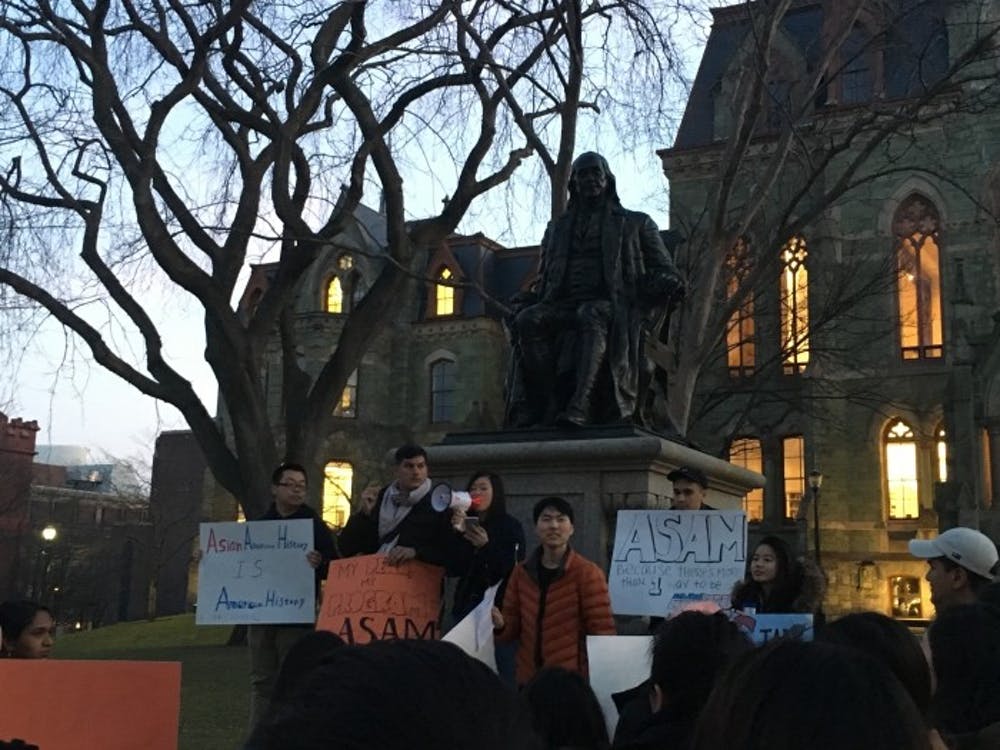
Though ASAM’s presence on campus has become more imperative than ever for Asian and Asian American students, its 25 years of existence are unfortunately defined by its institutional disregard by the University. The program, founded in 1997 after Asian American students, faculty, and staff rallied on College Green, continually faces a restrictive budget, faltering institutional support, and undervaluation as a legitimate course of study. In 2017, students took to College Green and Locust Walk again after founding faculty member and ASAM Director Dr. Grace Kao left Penn and the University made no announcement to hire an Asian Americanist faculty following her departure. Since then, ASAM has lacked a longstanding director and has continued to struggle for minimal resources.
When Dr. David Eng announced that he was slated to leave Penn after the 2020-2021 school year, ASAM faced increased destabilization, as he is one of the three remaining tenured Asian Americanist faculty who teach in the program. Furthermore, Dr. Eng’s potential departure would coincide with former ASAM Director Dr. Josephine Park’s sabbatical during the 2021-2022 school year, meaning another period of uncertainty over who can serve as ASAM’s next Director. An alumni petition of 800+ signatures and a faculty petition of 58 signatures called for Penn to make its strongest effort to retain Dr. Eng. However, no immediate response was made, and this lack of transparency from the University is one of the primary issues ASAM faces. While Dr. Eng will continue to teach at Penn, ASAM has not learned who will fill the Directorship after Dr. Park. Furthermore, the University also announced it would pursue a cluster hire of faculty for ASAM in March, but it has not shared concrete plans for how it will execute such a hire with the program’s student leaders, faculty, and staff.
This cluster hire is one of the largest efforts made by Penn to support ASAM, but why is Penn choosing to support its ASAM program now? As members of the UAB since our first years at Penn, we have attended several meetings with University administrators, such as School of Arts & Sciences Dean Steven Fluharty and Provost Wendell Pritchett, who have previously shrugged off our concerns time and time again. It is not lost on us that the University decided to implement this cluster hire exactly two weeks after Asian women were massacred in Atlanta. It is not lost on us that the College announced its Inclusion and Anti-Racism Initiatives after a summer of Black uprisings due to the police murder of George Floyd. It is not lost on us that it takes violence against Black, Indigenous, and non-Black communities of color in order for Penn to offer us the bare minimum of resources.
In April 2020 at the start of the pandemic, Penn created the Task Force on Supporting Asian and Asian American Students and Scholars at Penn (TAASS) in response to anti-East Asian xenophobic violence. There was little-to-no student consultation on how the Task Force could truly support Asian and Asian American students and scholars. TAASS upholds the carceral, white supremacist, and imperial logic that is at the root of the violence experienced by people of Asian descent across the globe. Co-chaired by Penn Global, this task force aims to center the East Asian international student population, ignoring how East Asian privilege dominates Penn’s AAPI community over minoritized AAPI communities such as Southeast Asians, Muslims, and Pacific Islanders.
Following the September 11th attacks, the rise of Islamophobia in the U.S. has only festered, violently targeting South Asian and West Asian communities. In 2012, it was discovered that the New York Police Department had been surveilling Penn’s Muslim Student Association along with other Muslim student groups across the Northeast. On our campus, a SEAS professor shared a series of blatantly Islamophobic tweets about the COVID-19 pandemic and faced no reprucussions by the University for causing this harm to Penn’s Muslim community. In response to this form of anti-Asian violence, Penn has launched no such task force. What’s more, the Asian and Asian American communities overlooked by the Task Force are those who are most harmed by carceral systems that directly corroborate with Penn’s Division of Public Safety, the other co-chair of TAASS.
For us, TAASS being co-chaired by Penn Police is the most appalling aspect of this Task Force, as it completely ignores how anti-Asian violence also includes forms of state violence such as incarceration, deportation, and war. Although President Biden condemned anti-Asian xenophobia during his first presidential speech on March 11, 2021, his administration deported 33 Vietnamese migrants just four days later. Several of the deported community members were formerly incarcerated refugees, who were displaced by U.S. militarism as infants during the American Cold War interventions in Southeast Asia. The co-existence of these truths deeply illuminates the true insidious nature of anti-Asian violence, and TAASS is complicit in upholding this violence by appointing Penn Police as its co-chair.
At best, this Task Force is performative, and it is another manifestation of Penn’s utter blindness to its students’ real needs, as it does not address the lack of support internally for AAPI students on our campus with regards to student life or academics. ASAM and PAACH are incredibly under-resourced, yet Penn somehow has the money to build a new task force to divert funds away from communities necessary to Penn’s Asian and Asian American community. PAACH is an intentional community that houses a number of student organizations that support Asian and Asian American students of all experiences. Like ASAM, it too has struggled to hire an Associate Director for the past two years. The struggles of our already existing and vital Asian and Asian American spaces on campus are symptomatic of the University’s indifference toward the communities Penn claims to uplift, particularly those of students of color.
On behalf of campus student organizers — namely our Black, Indigenous, Latinx, Asian, queer, FGLI, and non-citizen peers — we, the ASAM UAB are tired of the urgent necessity of our labor that so often amounts to the hours of a part-time job from which no sincere, meaningful change is enacted. We as students should not have to fight to have our own personhood recognized by the University, and we are tired of our labor remaining invisible while the University continues to tout our work as their own virtuous charity. We are tired of Penn’s disregard of the needs of students of color, and we are tired of only being visible to the University when our feelings of sadness and rage in response to devastating violence become an opportunity for Penn to advertise its “commitment” to diversity and inclusion. However, we must continue to holding this University accountable in ensuring that our needs are met, and we need your support. Enroll in ASAM courses, go to ASAM events, join the ASAM UAB, and support the other ethnic studies programs at Penn (AFRC, LALS, NAIS)! Learn the history of these movements on our campus, and JOIN THEM. All our liberations are connected, and we should always demand more from our university.
Ableism at Penn | Table of Contents | Crisis in Higher Education
 Penn Disorientation Guide