
On May 13th, 1985, the Philadelphia government used military explosives to bomb the headquarters of MOVE, a radical Black environmentalist group, in the neighborhood of Cobbs Creek in West Philadelphia. As a result of this horrifying act of police violence, the bomb and resulting fire killed 11 MOVE members, including five children, and destroyed over 60 homes. The MOVE bombing and aftermath are a result of state violence, systemic racism, and institutional silencing of Black radical voices. Though frequently overlooked, this day illustrated police violence and institutional oppression in the U.S. at their most brutal—and it all played out just twenty blocks from Penn’s campus.
MOVE Organization and Bombing
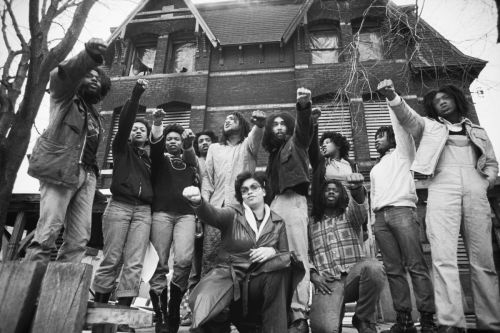
MOVE is a revolutionary religious group based in Philadelphia, with an ideology that centers Black liberation and environmentalism. It was founded by John Africa in 1972 and considers itself a family, with all members adopting the surname Africa. MOVE was politically active from the outset, demonstrating against police brutality and animal cruelty. Their revolutionary and pro-Black ideology caught the attention of the notoriously racist and conservative then-Police Commissioner Frank Rizzo. Rizzo harassed, threatened, and brutalized the group with the power of the Philadelphia police behind him. Surveillance and police brutality at the hands of the city cemented MOVE’s belief in militant self-defense.
The first large confrontation between MOVE and the police occurred after MOVE members refused to vacate their compound in Powelton Village following a court order, supposedly for building code violations. Philadelphia police blockaded the residence for 56 days; a steel fence was erected, their water supply was cut off, and police forbade food from entering the compound. On August 8, 1978, Rizzo sent in hundreds of officers to force them out and brandished water cannons at them. Shots were fired and one police officer died. Despite no forensic evidence linking MOVE and their weapons to the killing, 9 MOVE members were convicted collectively for that single bullet, and each one was sentenced to 30 to 100 years in prison. Two of them died in prison, and the remaining seven were released after around 40 years of imprisonment each, where they were subject to the abuse of the carceral system.
Their Powelton Village Residence was torn down after the confrontation (and before any credible investigation of the confrontation scene), and MOVE relocated to 6221 Osage Avenue in West Philadelphia. MOVE turned to fighting for the release of the MOVE 9. Neighbors became frustrated with the noise of blaring loudspeakers and “obscene” speeches and sought reprieve from the city government. In response, the city evacuated the block and again shut off water and electricity to force MOVE members out. With no surrender from MOVE members, officers threw tear gas canisters at the house and gunfire ensued. The new Police Commissioner Gregore Sambor ordered the compound to be bombed, ostensibly to remove the bunker on the compound’s roof. The bomb started a fire that Commissioner Sambor told firefighters to ignore, and it was left to burn to the point where it eventually engulfed the entire block. The only adult survivor, Ramona Africa, said that the police shot at MOVE members who tried to escape the fire. Once the fire abated, 11 MOVE members (six adults and five children) died in the fire and an entire city block was burned to the ground, leaving hundreds of people unhoused. Ramona was the only person ever charged with anything from the bombing, and she unjustly spent seven years in prison for riot charges. Philadelphia was only held liable for the bombing 11 years later in a civil suit. Victims received further compensation after a 2005 civil trial as well as a formal apology from the city in 2020, and only last year did the City re-classify the deaths of those they killed as homicides instead of “accidental.”
Institutional Mishandling of Victims’ Remains
Unfortunately, the tragedy of the MOVE bombing does not end here. The bodies of the victims were managed poorly from the start, as “machine operators crushed bones and mangled skeletons” while excavating corpses and debris. The bodies then decomposed in a city morgue for six months. The five children who died in the bombing would be buried in unmarked graves at Eden Cemetery, and only now do the graves have small markers. The city also did not conduct proper initial examinations or storage of the remains they received, and their documentation of the remains was “incomplete, inconsistent, and, at times, contradictory.” This destructive carelessness from the city, also made the remains difficult to identify later on. This would recently prove to be a big problem when both the city and Penn were found in possession of the remains of several deceased victims. Instead of returning the remains to the victim’s families, both institutions displayed distressing levels of negligence in their actions.
In 2021, we learned that the Penn Museum held onto the remains of MOVE bombing victims for decades. This was not the first time the museum had been implicated in unethical care of the Black people’s remains, as the University had just apologized for the Morton Collection (see: Slavery at Penn). In 1985, the city’s Medical Examiner’s Office gave some of the remains of MOVE victims to the custody of now-retired Penn anthropology professor Alan Mann, so the remains could be identified. This exchange took place despite the fact that giving remains to a third party without notifying next of kin was not in accordance with the city’s policies. Rather than being kept in climate-controlled storage at Penn, the remains were shelved in a cardboard box and handed off by Mann to another Penn professor, Janet Monge, who would go on to use the remains as class demonstration material several times.
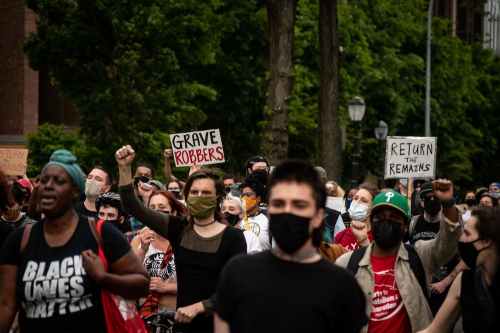
After the story reached national news, Penn apologized (twice), but their apology was criticized for falling short of being directly addressed to the Africa family. Additionally, on April 28, 2021, more than 300 West Philly residents and Penn community members protested outside the Penn Museum demanding the immediate return of the remains who the Africa family believed to be of Katricia “Tree” Dotson Africa, 14, and Delisha Africa, 12. The Africa family called for the return of the children’s remains, financial reparations, the firing of Monge, and an investigation led by MOVE among other demands in a petition signed by over 12,000 people.
Tree’s remains were returned by the University in July 2021 (her mother, Consuewella Dotson Africa, sadly died the previous month before she could bury her daughter), but Delisha’s remains were not returned. Mann and Monge deny ever receiving Delisha’s remains, but archival documentation contradicts their claims. Furthermore, Monge has not been fired but rather demoted by Penn. An investigation conducted by a law firm hired by the museum reported that Mann and Monge “did not violate any professional, ethical, or legal standards” but “demonstrated, at minimum, poor judgment and insensitivity.” Police Free Penn (PFP), a direct-action group at the University that advocates for racial justice, condemned the closed-door investigation for its absolution of Mann and Monge from institutional and legal accountability. Finally, there have still been no financial reparations from the University to the Africa family.
The City of Philadelphia made national headlines as well for retaining the remains of several MOVE bombing victims. The city’s collection, like Penn’s, included some of Tree’s remains. Philadelphia Health Commissioner Thomas Farley gave an order to Medical Examiner Sam Gulino in 2017 for the remains to be cremated and disposed of without identifying them or notifying family members. After Farley disclosed this information to Philadelphia Mayor Jim Kenney in May of 2021, Farley resigned from his post per Kenney’s request, and Gulino was put on administrative leave and never returned to his former position. Shortly after Kenney announced Farley’s resignation, it was discovered a subordinate disobeyed Farley’s orders and the remains were still in storage.
It should be noted that Farley was previously the city’s top health official, leading Philadelphia’s COVID-19 response. It is worrying to think that someone who displayed such poor judgment was in charge of caring for hundreds of thousands of Philadelphia residents. One might think that Farley would not be allowed a position in public health after his grievous missteps were made public, but Farley was in fact hired in November of 2021 as the senior deputy director of community health at the D.C. Health Department, where he was specifically tasked with addressing health disparities in the city. As Black Lives Matter DC said at the time, “It is unacceptable for this man to hold any position [in] District government,” considering how carelessly he handled the remains of Black MOVE bombing victims.
After an investigation into the city’s mismanagement of the remains, of which many unanswered questions still remain, some of the remains that were at some point identified as Tree’s and Zanetta “Netta” Dotson Africa’s were recently given back to their brother, Lionel Dotson. Despite the City of Philadelphia’s culpability both in killing Dotson’s sisters and disrespecting their remains, they still declined Dotson’s request to pay the small expense of his travel from his home in North Carolina to Philadelphia so that he could receive his sisters’ remains. In November of 2021, Dotson filed a lawsuit seeking damages against the City and Philadelphia for mishandling of his sisters’ remains. “It means a great deal to me. My sister can’t speak for themselves, my mother can’t speak for herself,” he said to the Inquirer. “I’m the voice for the voiceless.”
In 2024, it came to light that the Penn Museum was still in possession of the remains of Delisha Africa, a 12 year old girl killed in the MOVE bombing, despite the museum’s previous claim that it had returned all of the remains. Yet again, Penn displayed cruel carelessness and apathy in its handling of Black remains, behaving in a manner not only deeply disrespectful to the victims of the MOVE bombing, but also further traumatizing for the living members of MOVE, who have at this point spent four decades fighting for justice and basic dignity for the dead.
Although they happened decades ago, the MOVE confrontations demonstrate an ever-present pattern where governments use state-sanctioned violence to silence radical voices and action while using their official status to protect themselves from accountability. The aftermath further “shows that there’s [systemic] disregard for Black lives and Black afterlives,” said Abdul-Aliy Muhammad, the activist who first broke the story of Penn’s possession of MOVE bombing victims’ remains. The city’s actions during the BLM uprisings in 2020 mirror the tactics used against MOVE: brutal and militarized response to dissent, tear gassing residential neighborhoods, using arrests and charges to intimidate activists, lying to paint their actions as justified, and toothless, delayed apologies with no accompanying transformation.
Nevertheless, we might find a glimmer of hope in the fact that despite all the resistance against MOVE, the organization is still active and advocates for racial justice in Philadelphia. You can read more about their efforts on their Instagram, including their current fight to free their comrade Mumia Abu-Jamal. In 2021, several members of MOVE publicly left the organization citing histories of abuse and manipulation. To learn more about what happened and what that means for MOVE organizing, please listen to Mike Africa Jr’s 4-part podcast series “My Life in MOVE: the Good, the Bad, and the Ugly”.
Further reading:
- MOVE Organization Instagram
- On a Move with Mike Africa Jr. – podcast where MOVE member Mike Africa Jr. hosts weekly guests to “illuminate the issues and struggles of the people”
- 40 Years A Prisoner – documentary following Mike Africa Jr.’s fight to free his parents Debbie Sims-Africa and Michael Davis Africa Sr.
- Summer of ‘85 – 2022 audiobook by Chris Morrow, narrated by Kevin Hart
- Let The Fire Burn and Philly On Fire – Award-winning documentaries on MOVE and the 1985 bombing
- MOVE: An American Religion – 2020 book by Richard Kent Evans
- Opinion: The MOVE bombing was deliberate, not an act of last resort – Abdul-Aliy A. Muhammad for Billy Penn, 2021
- A Siege. A bomb. 48 dogs and the Black commune that would not surrender – The Guardian, 2018
- The day Philadelphia bombed its own people – Vox, 2019
 Penn Disorientation Guide