by Anonymous
The University of Pennsylvania is a powerful institution: it is worth over $20 billion and is the largest employer in the city of Philadelphia. This makes the University a key business in the area. As Penn continues to grow, it is essential for the University to responsibly manage its role as a major stakeholder in the city. Workers across the country have recently pushed for labor reform, and more Americans approve of labor unions now than any other time in the last 50 years, according to a recent poll by Gallup. Corporations — from Hollywood to UPS — have had their normal operations halted because of their failure to address the concerns of unionized workers.
As workers across the country demand better treatment and stronger representation, Penn stands in the way of organizing workers on campus and acts as a bystander while companies across Philadelphia implement similar union-busting tactics. Corporations, like Penn, use common union-busting strategies to keep workers divided, demoralized, and controlled.
It doesn’t have to stay this way.
On campus, Penn students have opportunities to develop meaningful relationships with workers they interact with on a day-to-day basis. 2020 Wharton graduate Michelle Lyu assisted in the reemergence of one of Penn’s major student-led labor organizing groups, Students Labor Action Project (SLAP). She said that it can be easy for students to “conveniently assume” that the workers in dining halls, custodial staff, and others are safe, happy, and secure in their employment. However, Lyu insists that it remains essential for incoming and current students to be honest with themselves and actively confront their relationship to the struggle of these workers.
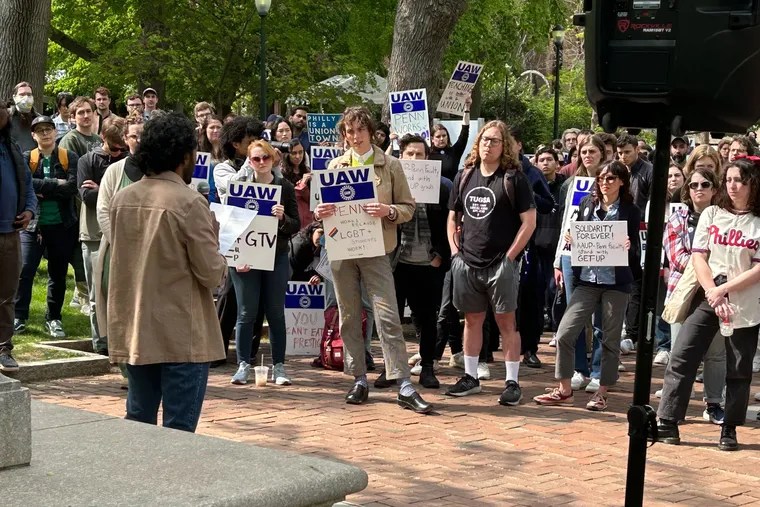
In addition to Penn workers and staff members, students at the University also have increasingly demanded labor reform for their on-campus jobs and roles. This past school year, nearly 2,000 student workers began their unionization effort, along with residential advisers and Penn Medicine residents and fellows.
Below, our goal is to briefly detail some recent examples of labor struggles on Penn’s campus and in Philadelphia before explaining how students can take advantage of their position and create meaningful change.
On campus
Residential Advisors
Last March, a supermajority of Penn’s residential advisors and graduate resident associates — the undergraduate and graduate students who maintain the University’s college house system on top of their coursework — filed to unionize with the Office and Professional Employees International Union Local 153 and the National Labor Relations Board. RAs and supporters of United RAs at Penn told The Daily Pennsylvanian (DP) that their key concerns driving the unionization process included: the limitations of their meal plan, discouraged employment for first-generation low-income students, and tasks that fall outside RAs’ job description.
“RAs are integral to campus life but are consistently undervalued and unpaid,” United RAs at Penn wrote in a press release. “RAs are organizing for increased and fair compensation, better communication, and a more democratic workplace — when RAs are supported, so is the entire Penn community.”
Nearly 1,000 people have sent letters to Penn in support of the unionization process, asking the University to not engage with anti-union campaigns.
This begs the question: has Penn stood aside and let the democratic process happen on its own?
The University’s initial response: Penn spokesperson Ron Ozio wrote in a statement to the DP that the University “greatly appreciates and values our Resident Advisors and Graduate Resident Advisors, who are important student leaders on campus. We are in receipt of the petition that was shared earlier today and are in the process of reviewing it.”
Days later, however, Penn published a Frequently Asked Questions page which propagated false and misleading claims about the benefits and harms of unions and hired a prominent anti-union firm to represent their interests.
The DP also obtained the Board of Trustees’ official statement of position which said that the RAs are “not employees” of the University, but instead classifies them as student leaders with an “educational relationship” to Penn since they are not on the payroll. At other universities where this issue appears students always come out on top.
In 2017, the NLRB’s acting regional director ruled that the right to unionization must be extended to RAs at private colleges after George Washington University attempted to argue that its educational relationship with its undergraduate resident advisers provided reasons to deny them labor-organizing rights. Recently, RAs at peer universities, including Barnard College, Wesleyan College, and Tufts University, successfully formed labor unions.
While other undergraduate and graduate student workers successfully unionize across the country, Penn implements delay tactics to push the union election back. However, students see through this. The DP published an editorial detailing the importance of allowing students the agency to make these decisions on their own – without the influence of corporations, like Penn, that don’t have their best interests in mind. The final vote is tentatively planned for this upcoming fall semester, but we’ll be sure to keep an eye out for any tricks that the University tries to pull out of its sleeves.
Penn Medicine Housestaff
Earlier this year, Penn Med’s residents and fellows became the first housestaff to unionize in the state of Pennsylvania. This win for labor rights did not come without obstacles, however.
Residents and fellows previously told the DP that they faced anti-union campaigning from their employer. Union organizers expressed confusion with regulations dictating when and where residents and fellows could vote.
While each department was assigned an election location to ensure votes were not counted twice, third-year internal medicine resident Jackson Steinkamp told the DP that he received confirmation from the NLRB that house staff could vote at any location. Votes cast at non-assigned locations just required additional processing.
Penn Med also allegedly posted signs encouraging the housestaff to vote no on the ballot outside polling locations. Some departments were directly told over email that they should not approve of the unionization effort.
Penn Museum
For years, workers at The University of Pennsylvania Museum of Archaeology and Anthropology claimed that they were subject to unsafe working conditions, faced problems with upper-level administration and management, and were paid unfair wages. Penn Museum itself had been subject to national controversy because of its possession of the Morton Collection and MOVE bombing victim remains.
In May 2021, they officially filed for a union, hoping to join the Museum and Cultural Workers Local 397. The University retaliated. Museum staff said that they were inundated with emails containing false and misleading information about unionization. University administration actively encouraged union-eligible employees to vote “no,” and museum management held captive-audience meetings to spread anti-union talking points. Chris Woods, Penn Museum’s director, disseminated a video where he implored workers to vote against unionization.
In response to these allegations, Penn Museum and University administrators emailed a statement to the DP, writing, “We fully support our employees right to make a free and informed decision, and we believe they are entitled to receive honest, factual information about the voting process and collective bargaining.”
Despite Penn’s best efforts, Penn Museum workers triumphed and won their union vote in August of 2021.
Computer Science TAs
For over five years, the DP has reported on the lack of resources available to the Department of Computer and Information Sciences (CIS) staff. Student Teaching Assistants (TAs) for CIS 1200 (previously CIS-120) have said that there is not enough space for students. Students have stated that the limited resources allocated to the CIS department forces them to wait hours before receiving homework help during office hours. More recently, the situation for TAs only worsened throughout the pandemic as many were forced to hold in-person office hours with no hazard pay — or any extra compensation for working through dangerous conditions.
CIS TAs also face consistent pushback from administrators and other staff during repeated attempts at unionization, according to Nico Melton, who organized a unionization attempt for CIS120 TAs in 2020. He said that throughout the process, “the administration and the higher-ups were constantly trying to pit us against each other.” Professors and head TAs alike constantly told them they were fighting a losing battle as there was no support for a union, and that a unionized TA body would only harm students and professors.
Nico explained that both statements were unfounded. Nico and fellow organizers found that over half of CIS TAs supported the movement, and argued that a unionized TA body would not negatively affect anyone. As TAs are usually full-time students as well, not paying them fair wages or providing benefits only exacerbates the toxic academic environment at Penn.
Off-campus
While there are key factors that make organizing on campus unique, it can be useful to look more broadly at unionization efforts across the city to understand the scope of these labor issues. It remains essential to stay informed about local labor struggles to find solutions for problems faced on campus or create solidarity with other workers across the country.
Across the nation, over 200 Starbucks Coffee locations have pushed for unionization while working with Starbucks Workers United. Last May, four Starbucks in Philadelphia voted to unionize. Two of these newly unionized stores are located on Penn’s campus: the Penn Medicine Starbucks and the Starbucks on 34th and Walnut street.
Before the official vote, workers at both of the Penn locations told The DP that their employers engaged in union-busting practices in an attempt to prevent collective bargaining. These measures failed as the official vote to unionize at the Walnut Street location was unanimous and the Penn Medicine vote passed by a wide margin of 10-1.
In a letter to former Starbucks CEO Kevin Johnson, the workers at the Walnut St. Starbucks wrote in solidarity, “We are forming our union because we recognize that the interests of Starbucks corporate are fundamentally opposed to our own interests.”
Outside of these local Starbucks, Philadelphia has encountered numerous other unionization efforts in the past year. Good Karma Cafe voted to unionize in March 2022—forming Karma United, an affiliate of Philadelphia-based Workers United. Korshak Bagels, a South Philly shop, voted to unionize in June 2021, and they are currently negotiating and finalizing their first contract.
Moving forward
Whether this will be your first semester on campus or you’ve been here for years, there is space for you to actively use your position to advocate for Penn employees and other workers in Philadelphia.
When looking at the current moment and deciding how to make a genuine impact, Lyu, someone who was in the same shoes as current Penn students not too long ago, advised people to reflect on how previous movements found their footing.
Describing how SLAP reemerged in 2019, Lyu said it was born out of a sustained connection she had made with a dining worker at Hillel Dining Hall. After a casual conversation with this worker – who explained to Lyu that management was not allowing them to celebrate Black History Month as visibly as they wanted to – the dining hall workers and students planned a joint rally to protest the leadership.
From this first event, Lyu said that “there was a very palpable beauty, vision, and energy” because “for the first time in a long time, campus workers and students were really standing side by side.”
Lyu added that the best activism is born out of hope and love. She urges students to see the humanity in each other and find a way to use their own skills and talents to improve what they see as the status quo.
“Young people who are first coming to Penn, especially freshmen, are very curious. They see a lot of possibilities, and they want to know what they can contribute and what is right,” Lyu said. “People are really drawn to a positive vision which, when it is presented to them as something that is moral and truthful, becomes something they want to engage with to make a difference.”
Further Reading:
The Daily Pennsylvanian | Dining hall workers at Penn Hillel demand better treatment from University
 Penn Disorientation Guide
One thought on “Penn’s Problematic History of Union-busting”