You may notice that underlying much of this guide — and most of Penn’s interaction with the world — is one principle: Penn is an engine of destruction for profit, determined to make money with very little regard for how that affects people, the planet, communities or ecosystems. Penn is a business first, and an educational institution second. However, this means that as a researcher, an investor, a pipeline of money and talent, and a power player in Philadelphia politics, Penn’s environmental impact is massive beyond its direct carbon emissions.
Penn loves to tout its own “green-ness,” despite its history of refusing to have dialogue, take accountability, or change. All the while, Penn knowingly upholds and profits from the industries responsible for climate injustice in Philly and around the world.Thus, Fossil Free Penn fights for climate justice and Philly community justice. Our tactics range from procedural actions such as submitting divestment proposals to disruptive actions like shutting down Board of Trustee meetings and encamping on the center of campus.
Penn and Climate
It is important to know that only a quarter of Penn’s generated emissions come from its campus and operations.However, these emissions alone don’t show the full scope of Penn’s impact on climate, climate policy, and extractive systems. While it often righteously points fingers at the ills of climate change, Penn is entirely opaque about its investment in climate chaos. By comparing Penn to other ivy league institutions with similarly large endowments, we can deduce that Penn could have anywhere between $838 million to over $1.7 billion invested in the oil, gas, and fossil fuel corporations responsible for polluting, destroying Indigenous lands, exploiting people and land in the Global South, and spreading false climate science. While Penn claims that it no longer “directly” holds investments in “companies focused on the production of fossil fuels,” this claim tells us nothing. Most universities’ holdings in fossil fuels do not come from direct investments. Instead, they come from investments held in private and public equity vehicles, or funds where multiple investments are grouped together. Princeton—which recently divested from fossil fuels—revealed that their direct investments in fossil fuels only comprised 0.03% of the endowment; all fossil fuel investments totaled 4.5%. Direct investments would have been less than 1% of Princeton’s total fossil fuel investments. Penn’s continued investment in fossil fuels likely looks similar.
Penn does millions in research for fossil fuel giants like Exxon and consistently fills career fairs and hiring events with extractors and their financiers, paving the way for further extracting and burning. The Board of Trustees is assembled with those who build corporate and personal wealth by investing in fossil fuels, fossil fuel infrastructure, the displacement of communities, private prisons, weapons, and more. Multiple current and former board members, including former University President Amy Guttmann, hold directorial positions in Vanguard and Blackrock, which together account for 17% of all global institutional investments in fossil fuel companies. The Penn Board of Trustees therefore has a vested interest in seeing destructive industries survive and thrive on our University’s campus.Since Penn’s inception over 275 years ago, they have systematically destroyed the West Philadelphia community (see: Black Bottom). They uphold industries that intentionally place dirty fossil fuel infrastructure in Black and brown communities; they declare such areas to be “blighted” and displace thousands; they build an enormous, militarized police force with a history of harassment. This year, they evicted 72 families from their homes. Penn’s message is clear: people don’t matter.
Penn the Advertizer: Greenwash, Gaslight and Greed
Penn is a talented marketer, and like most businesses, loves to make itself out as “green.” Click into links in this section to get deeper facts about Penn’s Greenwashing.
University advertises materials related to the Climate Action Plan 3.0 which weakly addresses campus emissions (which are, again, just a quarter of Penn’s total impact). While refusing to address divestment, the school claims to be pursuing a carbon net-zero endowment, using parameters that conveniently disregard 90% of the emissions caused by fossil fuels. At the end of 2022, President Liz Magill and Board of Trustees Chair Scott L. Bok also released “A message about Penn’s endowment and sustainability,” which continued to be self congratulatory with purposefully misleading language that caused campus confusion about the status of Penn’s investments in fossil fuels—the document implied that Penn had divested using the language of “direct investments,” obfuscating the volume of “indirect” ones they still held. Again and again, Penn loves to obfuscate, make vacuous promises, and paint themselves as a hero while making minimal change.
Environmental Justice is Racial Justice is Police Abolition is Housing Justice is Labor Justice
Fossil Free Penn is a student run, radical activist campaign demanding a just, democratized university that combats systems of destruction for profit. We organize around 5 central demands:

During the 2022-2023 school year, FFP campaigned around a narrower set of three core demands:
- Save the UC Townhomes
- Divest from Fossil Fuels
- Pay PILOTS
Fossil Free Penn: Action and Escalation – Join Us!
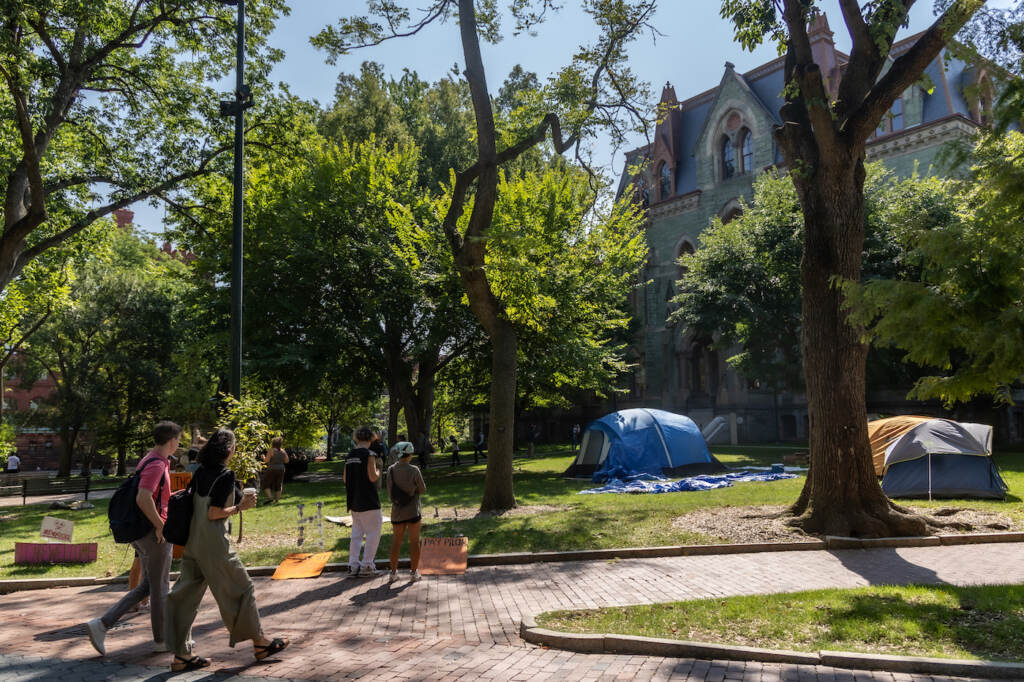
Since 2014, students, faculty, alumni, and the Penn community have demanded divestment and justice. We submitted multiple comprehensive proposals for full and partial divestment. All were ignored. After sit-ins, Board of Trustee meeting disruptions, and other forms of direct action, FFP led a broad coalition of activists to encamp on College Green for a week in April 2022, demanding of a terrified administration not just climate justice, but to Save the UC Townhomes, protect survivors of sexual assault, defund the Penn Police, and democratize the university. This encampment forced the administration to listen to us. Wendell Pritchett, then-interim President, sent members of the university administration to offer FFP a meeting with the administration in exchange for an end to the encampment, an offer that FFP declined because we felt that our demands were clear and actionable without a meeting.
Half a year later, FFP set up a second encampment that lasted 39 days from September 14th to October 22nd 2022 campaigning for: the UC Townhomes, divestment from fossil fuels, and the payment of PILOTS. As far as we are aware of, this second encampment was the longest lasting protest in Penn’s history. During this encampment, multiple university administrators came to the campgrounds asking for a meeting in exchange for the end of the encampment. We continuously turned down these offers because these requests showed the bargaining power FFP held when we held space proudly and visibly in the center of campus. The encampment culminated in a disruption of the homecoming football game, where 70 FFP protestors held the field for 50 minutes during halftime. The protest received national news coverage.
We have learned time and time again that the University would much rather punish students than entertain the idea of listening. While the university has tried to deter student protest through intimidation, disciplinary and even policing systems, they repeatedly find it difficult to justify any consequences for students.
During the first encampment, Penn police showed up with Penn administrators near midnight on the first night. They intimidated students by shining flashlights into tents, and even tried to grab a few students. Throughout the week, Penn administrators referred 11 students to the Office of Student Conduct (OSC, now renamed the Center of Community Standards and Accountability, or the CSA). All charges were dismissed. During the second encampment, Penn administrators continued to refer students to CSA; they took IDs from students on camp grounds at random during the daytime. When students deferred CSA meetings due to illness, wellness checks were sent to students housed on campus, and CSA lied about the severity of students’ illnesses (i.e. twisting “I’ve had a fever, I haven’t gotten out of bed” to say “this student said they couldn’t get up”) to justify them to house directors and RAs. All charges against students who had IDs taken at encampment were again dismissed.
CSA continued to intimidate students during the encampment by issuing retroactive charges to two students who they recognized during the UC Townhomes convocation protest. During the homecoming game protest, not only did Penn Police issue misdemeanor charges to arrestees after holding them at the precinct for up to 6 hours, CSA then imposed sanctions on students who were arrested. Penn Police were the ones who handed the identity of these students over to CSA by the CSA’s own admission. In addition, CSA imposed sanctions on students who stepped off the field before arrests that they identified arbitrarily as people who seemed to be more involved in Fossil Free Penn, but could not justify anything more punitive than asking students to write an essay. The arrestees had all of their misdemeanor charges dropped after each did 15 hours of community service and were put under probation by CSA, a verdict that was successfully appealed to be lowered down to a reprimand.
Since the formation of FFP, we have been able to force the university to take baby steps towards divestment. In 2020, Penn divested from coal and tar sands—which are regarded as some of the most destructive fossil fuel investments—after years of sit ins, divestment proposal submissions, and Board of Trustee meeting disruptions. Starting from the first encampment, FFP has been able to request multiple direct meetings between FFP members and University administrators to discuss the logistics of divestment. In 2022, Penn publicly announced that it no longer held “direct investments” in fossil fuels in response to the encampments and homecoming game disruption. While Penn has miles to go before full divestment, these wins prove that our tactics work.
Our strategy has been one of escalation and coalition building. We’ve worked to build stronger relationships with groups on campus and community organizations (such as Philly Thrive, The Coalition to Save the UC Townhomes, and Students for the Preservation of Chinatown), and plan to strengthen those ties through collective action this year.
The climate crisis is a result of the same story we repeatedly hear: a few people reaping capital with no regard for the wellbeing of others, the same unjust system of colonialism, extractivism, and capitalism. Our fight is deeply tied to that of our comrades—Penn must divest from all destructive industries. Alongside PAO, PFP, CAFSA, and others, we have pushed Penn to do better by the people it willfully harms.
Perhaps that is the biggest betrayal: Penn knows the consequences of their actions, and refuses even to acknowledge they do wrong, never mind to change. They are relentless in their inaction; we must be equally relentless in our pressure. This is our fight. Make it yours too.
 Penn Disorientation Guide
One thought on “Penn and the Climate Crisis: A System of Destruction for Profit”
Comments are closed.