by GET-UP
Introduction
Graduate Employees Together at the University of Pennsylvania (GET-UP) is a long-standing union campaign made up of graduate student workers who are employed as research assistants (RAs) and teaching assistants (TAs). Teaching and research student employees at Penn face low stipends, unclear expectations of work hours, insufficient benefits and campus accessibility, a lack of protections for international students, all-too-common harassment and abuse, and an employer that falls short of serving the broader West Philadelphia community.
Rather than facing administrators alone, we seek collective solutions to our collective problems. While our student governments can provide helpful suggestions or petition the university to improve the lives of student workers at Penn, they depend on the good will of the university to implement these suggestions. Through our federally-guaranteed right to collective bargaining, we seek a democratic say in our working conditions with an equal seat at the negotiating table with the Penn administration. At present, we are finishing a union authorization card campaign that has garnered support from well over 2,000 graduate workers going into the 2023-2024 school year. This year we will file those cards and seek legal recognition from the National Labor Relations Board (NLRB).

History of GET-UP

GET-UP is not a new effort. Penn has slowed, stalled, and fought the unionization process for over 20 years. Graduate students first formed a unionization campaign at Penn in the Fall of 2000. In Spring 2003, GET-UP held an election to formally unionize, and exit polls indicated that the majority of graduate students voted in support of unionization. But Penn’s administration suppressed the democratic decision by challenging the vote. In the following year, the Republican-controlled NLRB ruled against the right of TAs, RAs, and proctors to unionize, preventing efforts by student workers at Penn and other private universities across the country for over 12 years.
Still, student workers’ fervor for a union continued. When the NLRB declared in 2016 that Columbia student workers were employees and could vote to unionize, Penn graduate students were already organizing their fellow grad workers through a revived GET-UP. However, the administration’s resistance was also alive and well. When GET-UP filed its petition to vote on unionization in 2017, Penn challenged it. By the time the NLRB approved the vote, Republicans again controlled the NLRB under Trump. Along with campaigns at other universities, GET-UP decided to withdraw its petition in 2018 to prevent legal challenges to existing student worker unions.
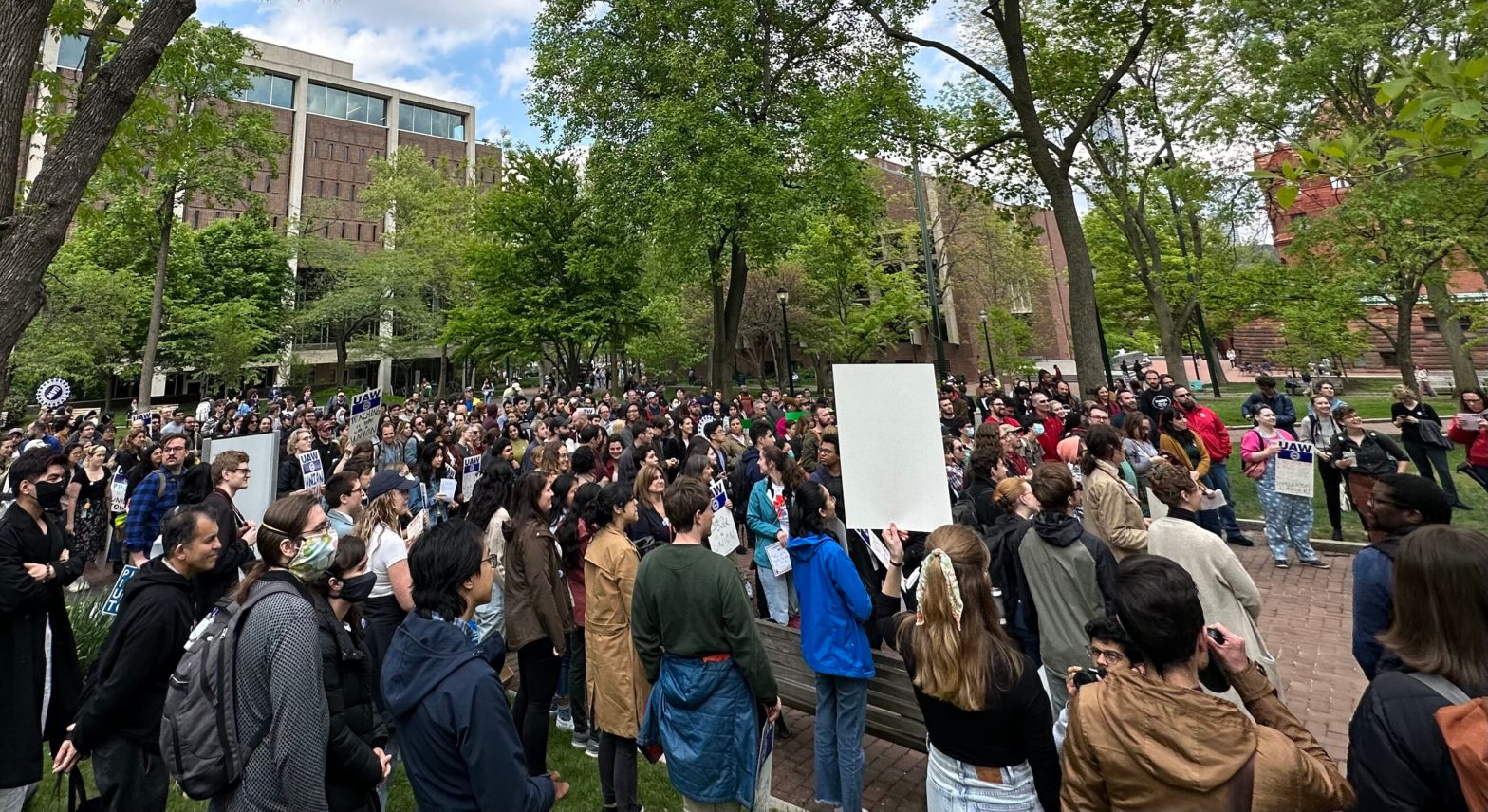
But Penn grad students never stopped mobilizing support for unionization–especially with the onset of the COVID-19 pandemic, which deepened issues that many workers already faced. Our organizing, alongside a Biden-appointed and labor-friendly NLRB, led to a renewed authorization card campaign in Spring of 2023. We went public with our campaign at a widely-attended rally. Amid a wave of student workers across the country winning union elections and negotiating fairer contracts, we are demanding that the administration recognize our value to the operations of the university. We now know Penn’s playbook and remain motivated to demand better for ourselves, for fellow student workers, and for Penn as a whole. In our current campaign, we have majority support and are working to strengthen that support while preparing to file a petition for legal recognition with the NLRB.
While GET-UP’s current card campaign is focused on graduate student workers, we support campaigns for as many workers unionizing at Penn as possible, including undergraduate student employees. Many undergraduates conduct similar teaching and research work as teaching assistants, learning assistants, and research assistants. Penn’s academically rigorous environment, combined with students’ extracurricular commitments, necessitates higher pay, job security, and contract transparency. Undergrads are also full-time students, and should be able to make a fair wage that doesn’t require long hours on top of coursework in order to make ends meet.
What we stand for:
A legally recognized union gives us a democratic say in our working conditions. Penn has exploited student workers through excessive workloads, low stipends, inadequate health insurance, workplace harassment, and lack of support for international students. The university has failed to address these concerns, and will likely continue to ignore them if not compelled to change. It is Penn’s responsibility to support student workers who are vital to university operations and who sustain research and undergraduate education. Student workers currently do not have an avenue through which to remedy long-standing issues.
What we want:
- Safe, fair, and transparent working conditions: TAs often face excessive teaching loads, and RAs lack paid time off and often encounter unsafe lab conditions.
- Financial security: The cost of living in Philadelphia has increased, but our pay has not kept up—we need financial security to make Penn a more accessible place to those who are excluded from academia.
- Protections against harassment and discrimination: Workplace harassment is widespread at Penn and students workers lack real recourse for mistreatment and discrimination. We demand protections against retaliation, transitional funding to support students to change labs and advisors, union representation at meetings about employment status, and third-party arbitration to resolve issues of harassment, discrimination, and abuse.
- Comprehensive and inclusive healthcare and benefits: Our healthcare and benefits often fall short of what we really need, excluding vision and dental insurance.
- Power, protection, and equality for international student workers: International student workers face additional costs and burdens associated with relocation, visa applications, and taxes, and are often subject to discrimination and heightened exploitation. By forming a union, we can win legal aid, paid leave, options for remote work, waived fees, and other forms of support for international workers.
- An accessible campus: Workers are excluded from participating in academic life when Penn doesn’t adequately consider disabilities, families, and health needs. By forming a union, we can secure both individual accommodations and systemic changes in campus infrastructure, healthcare, transportation, working hours, leave policy, workers compensation, family support, and childcare.
- Justice for our neighborhood and city: Along with many Philadelphians, our struggles with housing affordability, transit, safety, and racist policing are effects of an institution that has often failed in its commitment to the well-being of this city.

Unions are an avenue through which we can demand the university do better by its workers and community. If you want to contribute to making such a future a reality, here’s what you can do:
- Are you an undergrad interested in how a union could strengthen the voices of undergrad student workers? Fill out this interest form.
- Are you a graduate student who is paid for work as a research or teaching assistant? Sign a card!
- Not a graduate RA or TA but want to support the current card campaign? Share this link with any graduate workers you know! https://getup-uaw.org/card/
You can follow us on Instagram @getupgrads and Twitter @GETUPGrads for updates and events.
 Penn Disorientation Guide