by Anonymous
Hidden in plain sight along Locust Walk is Penn’s very own Center for Community Standards and Accountability (CSA), right next to the Arts, Research, & Cultural House. Formerly known as the Office of Student Conduct (OSC), this office handles disciplinary cases at Penn, including multiple recent cases against peaceful protestors. Specifically, CSA’s role is to determine discipline for students who have been found to be violating any university guideline – including the Guidelines on Open Expression which were established in the late 1960s in response to campus protests.
The process is complicated and not clearly outlined on any university document or website. But thanks to repeated subjection to the disciplinary process, activists at Penn have become increasingly familiar with the process. We hope that this article can serve as a guide to future activists at Penn on how to navigate the University’s disciplinary system.
The Open Expression Process
At all university events, Open Expression Observers, who work under the Vice Provost of University Life (VPUL), can volunteer to attend and notify anyone if they believe they are breaking the Guidelines on Open Expression. If someone is notified that they are in violation of the rules and does not stop what they are doing, they are referred to the CSA, who will assign them a case manager. The accused student can then choose from a list of CSA advisors or ask a professor they know to help navigate this process
After that, the students will have a meeting with their case manager to review the facts of their case, after which CSA will determine what they consider to be an appropriate sanction, which can range from a warning to expulsion at the most severe level. If the student feels the outcome is unfair or there are other facts to your case that weren’t considered already in the decision, they can submit a counterproposal for a different sanction. If the counterproposal is rejected, the student will have a hearing for their case which is composed of three students selected from the University Honor Council and two faculty members.
Recently, activists found multiple issues within the disciplinary process while dealing with CSA cases.. First, there is no check on VPUL’s power, meaning they can call students into tedious CSA processes at will. For the ‘22-’23 school year, Ms. Tamara Greenfield King held that position as interim provost. This year, Dr. Karu Kozuma will fill that role.
VPUL has violated their end of the university’s rules multiple times since Spring 2022, and university officials have shown a general disregard for the rights of student protestors under their own guidelines:
- During the first Fossil Free Penn (FFP) encampment in Spring 2022;
- University officials and police woke up students in the middle of the night for the first two nights, demanded IDs, unzipped their tents, and touched one student.
- During proceedings for the Convocation protest in fall 2022;
- In relation to the CSA proceedings that one student was subjected to, the student said “As a private institution there is no accountability to make Penn respect students’ rights. One official, Senior Case Manager Ken Lechter, told a faculty member he “[didn’t] think that’s really important” that rules be followed as written regarding surveillance and disciplining of students, and his superior, Julie Nettleton, called following guidelines a ‘perfunctory exercise.’”
- During the FFP second encampment in fall 2022;
- Administrators demanded University IDs from protestors despite knowing that the protest was protected by the Guidelines on Open Expression on a daily basis
- Ms. King took pictures of protestors in violation of section V.B.4 of the Guidelines on Open Expression
- Ms. King told all students who were sitting on the same section of College Green as FFP that they were in violation of the Guidelines on Open Expression (whether they were affiliated with FFP or not) and attempted to take a picture of a student who was sitting and studying, again violating section V.B.4 of the Guidelines.
- Two students notified CSA that they were going to miss a meeting due to illness. As a result, CSA notified their RAs, leading to two instances of bewildered RAs checking in on these students. CSA initially claimed this decision was out of concern for these students and then later admitted in a meeting with professors that were advising FFP on their CSA processes that it was because they suspected the students were lying about their illnesses.
- During both encampments;
- Ms. King and other administrators didn’t identify themselves as such while they were demanding University ID’s from students, violating section V.B.1 of the Guidelines on Open Expression.
- While section V.C.2 of the guidelines states that the Vice Provost “shall obtain the advice and recommendation of the representatives of the Committee on Open Expression (COE) whenever feasible” no effort was made to consult COE.
- The Vice Provost of University Life (first Ms. Accapdai in spring 2022, and Ms. King in fall 2022) were unable to identify which guideline protestors were violating. FFP was later found not to be in violation of any of the Guidelines at both encampments.
- During the Homecoming protest on October 22nd, 2022;
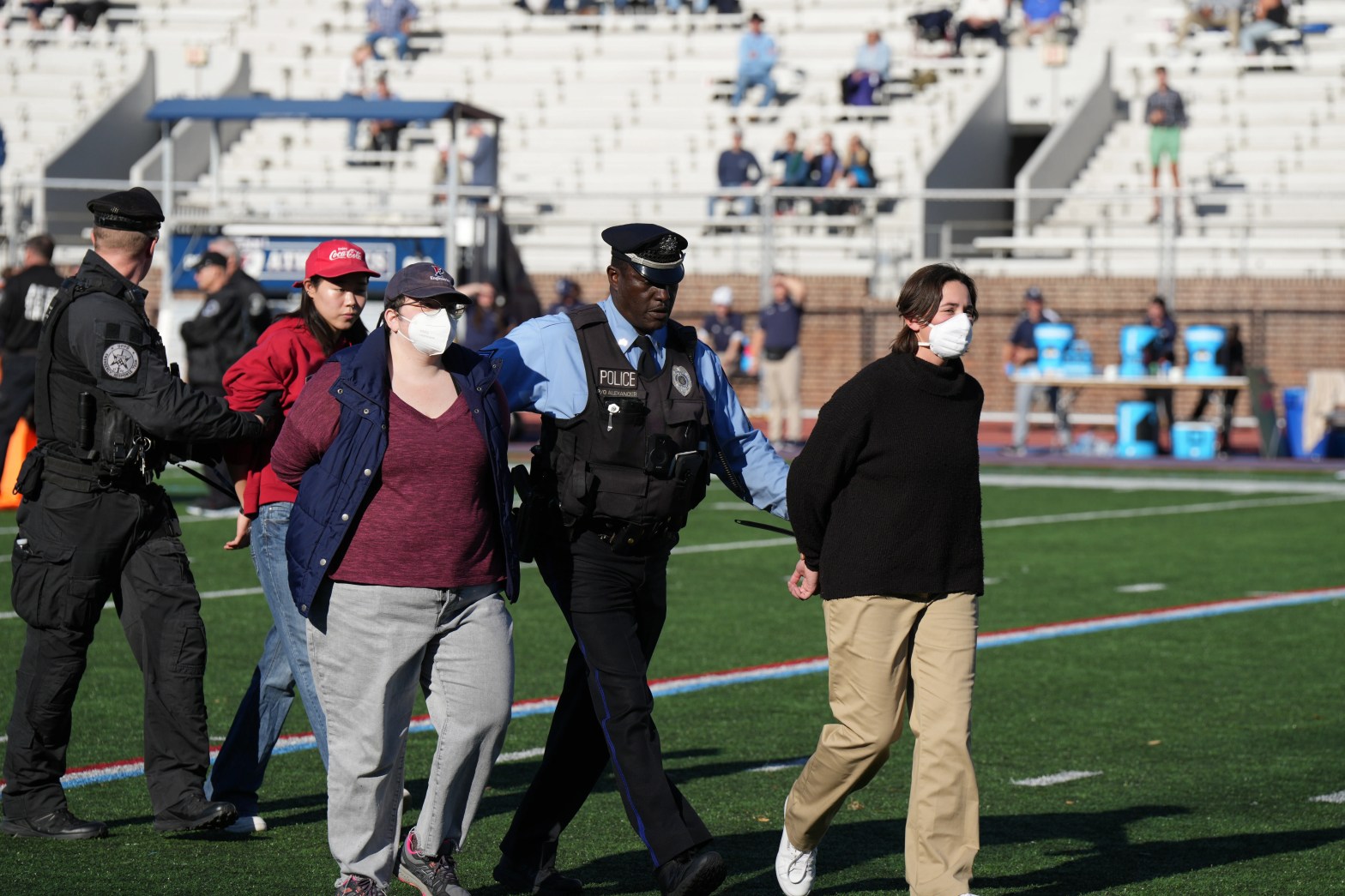
- While CSA claimed that their office was separate from the legal process against protestors by the University of Pennsylvania Police Department, protestors later learned in a meeting with their case managers that they collected video evidence from police body cams to use in the disciplinary process against the students.
- Ms. King and Ms. Bonner aided police in arresting students during the protest, by handing them zip ties and being in communication with the police throughout the protest.
- In February, when protestors interrupted an alumni dinner that Liz Magill was speaking at;
- Open Expression Observers identified themselves immediately and the police were swiftly called, despite the fact that the protest was small and nonviolent. The students left Huntsman before police arrived and no CSA disciplinary process was started for the students.
- During a protest of the March 2023 Board of Trustees meeting;
- Students were told that they couldn’t enter “due to a change in policy about allowing students and the room being too full” even though all Board of Trustees meetings are open to the Penn community.
One important rule to note in the Guidelines to note is section III.B.3. This guideline leaves a gaping loophole that allows VPUL their unregulated power which states;
- Individuals or groups violate these Guidelines if they continue to engage in conduct after the Vice Provost for University Life or delegate has declared that the conduct is in violation of the Guidelines and has instructed the participants to modify or terminate their behavior. Prompt compliance with the instructions shall be a mitigating factor in any disciplinary proceedings based upon the immediate conduct to which the instructions refer, unless the violators are found to have caused or intended to cause injury to person or property or to have demonstrated willfully in an impermissible location.
- If the individuals or groups refuse to comply with the Vice Provost’s or delegate’s order, they may challenge the appropriateness of the order to the judicial system. If the judiciary finds that the conduct was protected by the Guidelines, all charges shall be dismissed.
- Individuals or groups complying with the Vice Provost’s or delegate’s order may request that the Committee on Open Expression determine if the Guidelines were properly interpreted and applied to their conduct.
The result of this set of rules in practice is that even if someone isn’t violating the guidelines or doing anything wrong, if a delegate from VPUL claims that you are, you must be subjected to the disciplinary process, whether that is a fair call or not. Additionally, when FFP requested that COE be consulted, they were repeatedly told that they only serve an advisory role and while they could be included, their opinion would only be applied to future situations.
Ultimately, subjecting student protestors to the disciplinary process is a tactic that takes away resources from organizing time and energy, even when charges are dismissed in the end. It causes undue and unnecessary stress for students who are put through the process. Most significantly, it creates a culture of fear on campus for students to participate in student activism in the future. As the Civic Ivy, Penn should celebrate and engage earnestly with its vibrant culture of activism and civic participation, but instead the University has tried to suppress this culture.
But despite Penn’s efforts, activism on campus has remained vibrant in large part thanks to protestors receiving widespread support from students, faculty, and community members. FFP’s petition to drop all CSA cases and reform the disciplinary process and Guidelines on Open Expression received over 1,000 signatures. Activists at Penn have also learned strategies on how to manage the disciplinary process. The following are tips for future protestors for engaging;
- Document any unjust treatment: Record any interactions with University administration where they are violating University rules, and record any interactions with police. Make it clear that you are recording and save the recording in a secure place.
- Stick together as a group: Often many students are called to CSA hearings for the same alleged behavior, but CSA treats each of these cases individually and tells you that you must meet with them individually with your individual faculty advisor. Push to meet as a group with all of you and your faculty advisors. This step ensures that no one student can be intimidated or unfairly receives a harsher punishment.
- Know the Guidelines on Open Expression: Know them better than Penn administrators know them. If you are in a situation where you and an administrator are in disagreement about whether or not you are in violation of the Guidelines, you need to be able to cite your sources. You can read the Guidelines for yourself here.
 Penn Disorientation Guide
One thought on “A Protestor’s Guide: How to Navigate Penn’s Administrators and Disciplinary System”