by Anonymous
This year, Penn’s Asian American Studies Program celebrated its 25th anniversary. For 25 years, the ASAM Program has impacted numerous students who have chosen to pursue its courses and even its minor, offering them the opportunity to explore the unique intersections of an Asian American, Native Hawaiian, or Pacific Islander identity. The ASAM Program was the result of countless and constant efforts on part of students and faculty, and its existence holds an important place not only for academic enrichment but for students who fall under the AA+NHPI label at Penn. While it is important to celebrate the program’s tenacity, it is equally important to understand the program’s past, specifically Penn’s consistent institutional disregard of the program and its students and faculty.
Penn’s relationship with the ASAM Program can be summed up in one word: reactive. Through crisis after crisis, Penn has only chosen to respond to questions of recruiting faculty, funding, and expanding the program after they are caught in the crosshairs of student activism. This disposition toward ASAM can be seen throughout its entire history.
ASAM at Penn began in 1990, when the Asian American Student Alliance, the precursor to the Asian Pacific Student Coalition, in addition to other faculty lobbied then-Dean Hugo Sonnenschein to create a program focused on the experience of Asian Americans and their history. With the help of consultants and a small advisory committee, they led the creation of the Asian American Studies minor. Six years later, ASAM at Penn was officially established. What was described as a “weekly lecture series” had evolved into a “formal academic program.”
ASAM continued to grow until, in 2008, the University proposed a budget cut for the ASAM Program. In response, there was student and faculty outrage, and then-ASAM Director Kao threatened to resign. Student and faculty protests culminated in a meeting between administration and ASAM officials, after which, the University reaffirmed its “commitment” to ASAM, and the budget dispute was seemingly resolved.
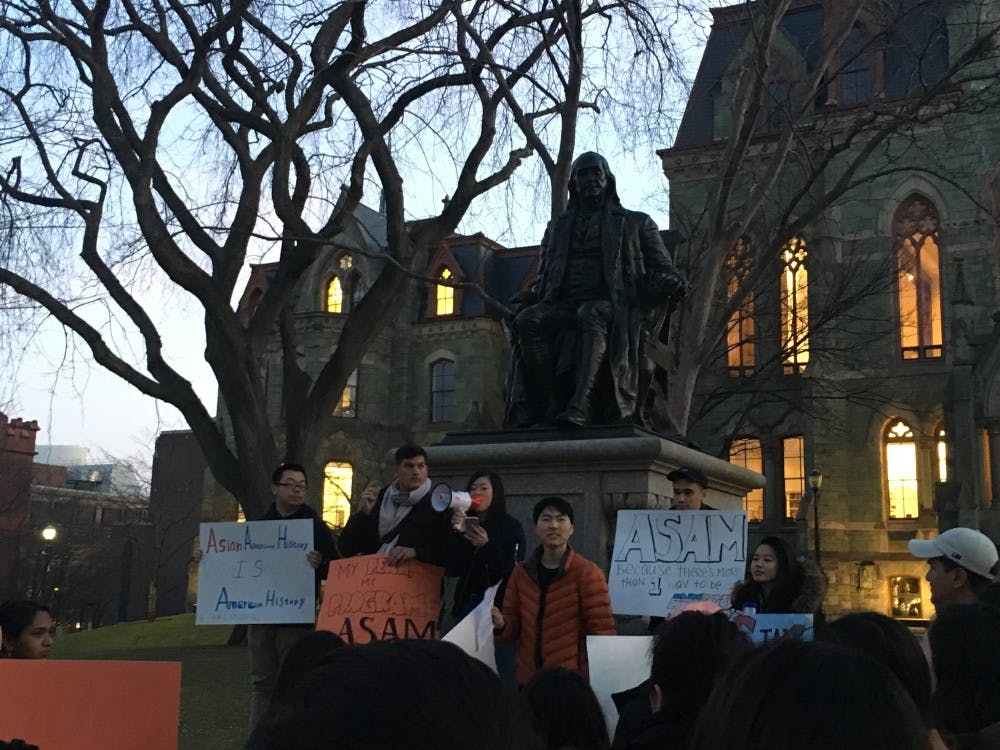
Then, ASAM was once again faced with another challenge when Director Grace Kao left Penn for Yale in 2017, the program’s 20th anniversary. She spent 20 years expanding ASAM, but even after two decades of her work, the Program had stagnated, facing a lack of funding, no new faculty hires for tenure-track, and a lack of legitimacy. Again, students took to activism. Students protested on College Green; ASAM’s Undergraduate Advisory Board (UAB) wrote an Op-Ed in the Daily Pennsylvanian and created a petition with over 1,000 signatures, contacted administration, and held an open forum. Although they were initially ignored by administration, specifically Dean Fluharty, several times, eventually the dean responded that “Penn will continue our strong commitment to the Asian American Studies Program” in an emailed statement to the DP.
In 2018, the University hired Senior Lecturer, Dr. Rupa Pillai, and the program grew to include two more courses. But, cyclically, doubt rocked ASAM again in 2021, when Professor David Eng announced that he was considering leaving Penn due to a lack of support from the University. Although Professor Eng decided to stay at Penn, his discontentment with the University is justified, and it is an exemplative of the University’s demonstrated disregard.
Simultaneously, in 2021, we witnessed a rise in anti-Asian hate crimes and a particularly horrific shooting of Asian women in Atlanta. The University’s announcement that they would implement a cluster hire two weeks after the Atlanta shooting reveals that Penn only chooses to support the ASAM Program when it appeals to them optically rather than in response to routine efforts on part of students in the UAB and faculty. When ASAM professors are rightfully exhausted from trying to keep the program afloat, and they decide to leave Penn or at least consider it, that is when Penn miraculously conducts hiring clusters and listens to student and faculty demands.
After disregarding former Director Kao and reacting to a wave of student protests in 2017, and then repeating the same process again in 2021 with Professor Eng, did the University respond to any concerns. The University has reliably demonstrated for the past 25 years that they do not care about Asian American Studies. Despite ASAM’s function as a trophy for bragging rights within the Ivy League, Penn has done very little to show its AA+NHPI students and faculty their “strong commitment” to the ASAM Program.
If you are a student interested in ASAM, use the program to its fullest potential. Get involved in Penn’s cultural spaces in ways that interest you. Take ASAM courses, attend ASAM events, and get involved in the Pan-Asian American Community House (PAACH) and other cultural spaces on campus. ASAM, and all of the other cultural programs and resources, like AFRC, LALS, and NAIS, were built on the backs of student and faculty activists that fought fiercely with Penn to make these resources available to us, so take advantage of them!
 Penn Disorientation Guide
One thought on “The Erosion of Asian American Studies”
Comments are closed.