Note: The article that has been adapted for this piece was originally written for the Daily Pennsylvanian on 11/8/21.
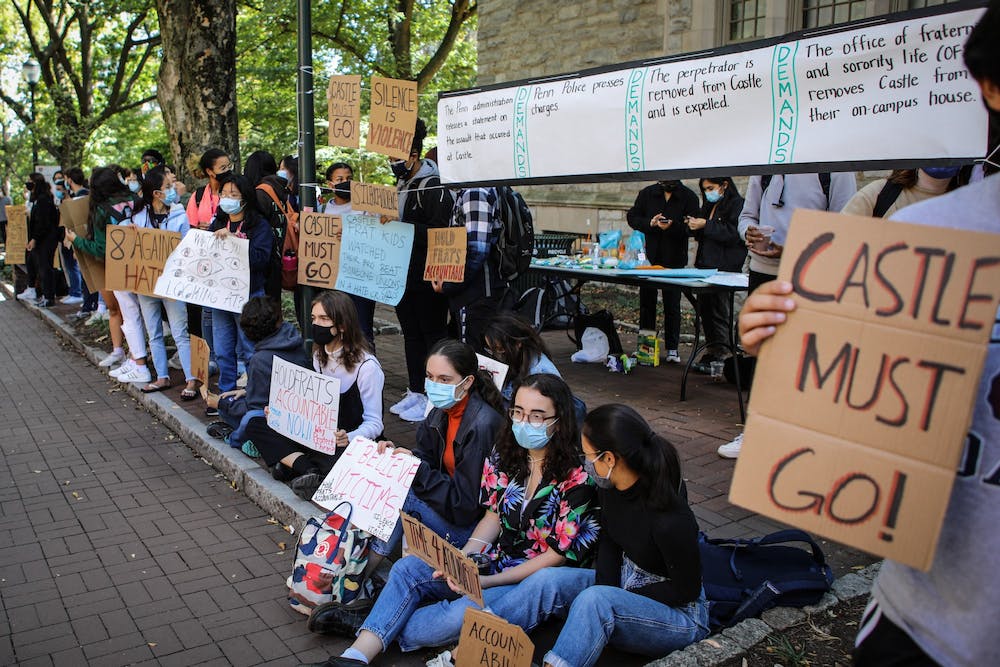
A towering house, fit for a king. A cardboard sign reading “Racists live here,” and a crowd of students chanting “Silence is violence.” Chalk graffiti on the red bricks of Locust asking, “No one did anything. Would you?”
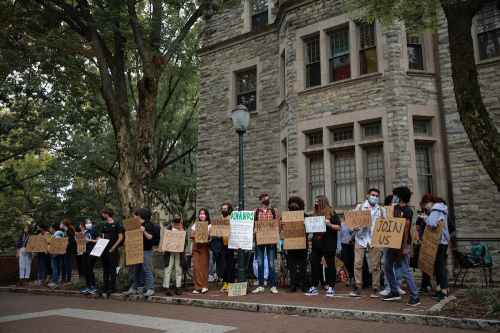
Almost immediately after the story broke about the alleged assault of a Penn student by a Castle fraternity brother in the early morning of Sept. 4, 2021, the campus mobilized. Outraged by the incident and the administration’s reticence, a group of student organizers wrote a list of demands and held a weeklong protest on the Castle patio. Some circulated a petition to kick Castle out of their house, and others hung up posters across campus calling to “End Frat Culture.” The incident — and the subsequent response — became the talk of campus.
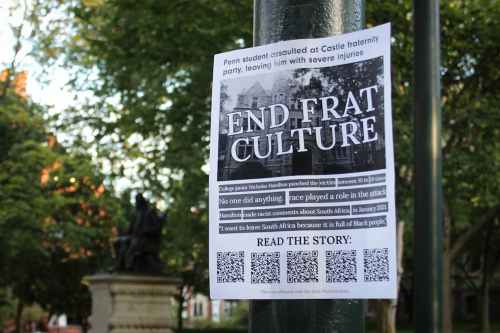
This story, however, is not an aberration from Penn’s 270-year history. It’s just another point on the timeline of fraternity violence, student outrage, and the administration’s silence.
Greek life commands university space and identity. Walk down Locust, and you’re just as likely to see a fraternity house as an academic or cultural building — they’re prominent both in the literal and figurative beating heart of campus. In fact, a whopping 25% of students belong to Greek life. The ubiquity of Greek life at Penn has been a point of contention for decades. In 1991, the “Report of the Committee to Diversify Locust Walk” stated the committee’s discontent with the atmosphere of exclusivity caused by fraternities on Locust, which often manifested as “verbal and physical harassment”, and urged the University to uphold its message of diversity and inclusion by replacing Greek houses on Locust with cultural centers.
Despite the thirty years that have passed since the report’s publication, its findings still resonate. It’s true that Penn has converted a number of Greek Houses into academic or cultural spaces. The Kappa Alpha house is now the Perry World House and Theta Xi is now the Penn Women’s Center, among others. But issues persist — the minority cultural centers on campus are located in tiny rooms in the basement of the ARCH Building, which is, coincidentally, directly across from Castle (see: Cultural Houses). In 2019, the Penn Violence Prevention (PVP) building, aimed at providing students resources for handling sexual and relationship violence, was relegated to an off-campus space. PVP has since been moved to the University Life building on Locust Walk, however, the building has insufficient private space for survivors and is not elevator accessible, which poses an issue for disabled students.
Not only are fraternities a physical force to be reckoned with on campus, but they’re also deeply embedded into University bureaucracy. Out of the 32 fraternity and sorority houses on Penn’s campus, the University owns 24. Not only does this exempt fraternities from paying property taxes, but the University also covers maintenance and repair costs. This relationship is ultimately lucrative. In the world of Greek life, business trumps brotherhood — a 2020 Daily Pennsylvanian report found that Penn makes up for over $10,000 worth of deficits, and another report estimates that Greek life alumni are significant donors to universities. Penn, already an elite institution that prides itself on a strong and wealthy alumni list, wouldn’t want to alienate its donor base by, say, abolishing Greek life.
However, Greek life causes more problems than it is worth. Greek life is designed to be exclusionary by nature. Originally created as social clubs for wealthy white men, fraternities only abandoned their whites-only membership clause in the 1960s. Today, Greek life is still overwhelmingly white and rich. And when these fraternities literally occupy fortified castles in the center of Locust, it’s clear who lies at the top of the campus social hierarchy.
The alleged racially motivated assault at Castle joins a long history of racialized violence in Greek life, particularly at Penn. In 1988, members of Zeta Beta Tau hired black women to perform at their rush event. Members shouted racial slurs and even physically molested the women. In 2016, a Mexican-American Penn sophomore accused white Sigma Nu brothers of assaulting him and taunting him with racial stereotypes. In that same year, a Pi Kappa Alpha member sent a racial slur to the fraternity’s listserv, and current members and even alumni then responded to that email chain with slurs and hate-filled speech of their own. In 2019, a Kappa Alpha Theta pledge allegedly shouted “I love Donald Trump” and “Build A Wall” at a Mexican-American student as a part of her hazing process.
Castle is also no stranger to violent crimes. In 1990, ten Castle brothers abducted and assaulted a rival fraternity brother. They kidnapped him from his home, blindfolded him, bound his limbs with duct tape, and handcuffed him to a playground pole. They then proceeded to torture him for over four hours. Castle was banned from campus for eight years (and was even briefly replaced with a community service residential program). Yet the university allowed Psi Upsilon to return in 1998, and not one student was expelled for the incident.
Additionally, fraternities are notorious for being cesspools of misogyny and harboring a culture that promotes sexual coercion. A 2019 AAU Campus Climate Survey reported that since entering Penn’s campus, 25.9% of women have experienced unwanted sexual contact. The single-most frequent location of this sexual violence? Fraternity houses.
Incidents of sexual assault in Greek life at Penn date back years, perhaps the most salient example being a 1983 gang rape at Alpha Tau Omega. ATO, of course, denied any such event, calling it a “gross exaggeration” in an official statement. A fraternity brother, on the other hand, was quoted by the DP saying “[the victim] was loose and wild, imbibing many things…” An internal investigation from the University recommended that ATO’s recognition be revoked, but after a lengthy court battle, ATO was ultimately suspended for just six months with no charges.
Rape and rape culture is not an issue of a bygone era. In 2016, off-campus fraternity OZ sent an email imploring first-year women to “wear something tight” to their “first showing.” In response, students posted flyers across campus with the words “THIS IS WHAT RAPE CULTURE LOOKS LIKE.” The incident gained national media coverage. A year later, only five out of Penn’s 27 fraternities attended mandatory education programs on sexual health and violence. Many were excused by the Interfraternity Council, and others were imposed with a mere $100 fine.
Fraternities across the nation are notorious for escaping consequences, and Penn is no exception. So how is it possible for fraternities to operate with such a level of impunity, shoving bigotry under the rug and constantly deflecting accountability?
Greek life has walls all but impenetrable to justice. The University provides recognition to Greek life on campus in order to establish “a commonality of goals and standards,” as well as “mechanisms of accountability.” Supposedly upholding this accountability is an array of bureaucratic structures including the Office of Sorority and Fraternity Life, the Interfraternity Council, the Intercultural Greek Council, and a Greek Alumni Council. Instead of accountability, these structures seemingly provide more layers of protection.
Over a month after the alleged Castle assault, the University has remained tight-lipped about the entire incident. The administration has only stated that an investigation is taking place. There have been no other news or updates. The Office of Fraternity and Sorority Life has declined requests to comment, appearing entirely absent from campus discussion around the incident. The student community, by and large, has been left in the dark.
Greek life is deeply woven into the fabric of Penn — not just in how the University makes its decisions, but in how students interact with the campus, each other, and their identities as Penn students. After the Castle assault, we need to reevaluate Greek life’s interdependent relationship with Penn. It’s important to understand that these aren’t isolated incidents, and they aren’t endemic to a specific fraternity. They have been occurring since fraternities existed, and will continue to occur in the absence of any accountability.
Penn is completely driven by money and image, both of which are central to fraternity life. When those things are threatened, they respond. The truth is Penn could have replaced the fraternities years ago. They have the ability to buy or stop renting the buildings the Locust fraternities occupy, but they won’t. They won’t unless we continue to push.
Despite decades of toxic Greek life, there are still ways to stay safe and fight back at Penn. Groups like the Coalition Against Fraternity Sexual Assault (CAFSA) aim to do exactly what the 1991 Committee to Diversify Locust Walk requested over three decades ago – replace the fraternities on campus with cultural and student resource centers. Such massive issues do not get resolved overnight and will likely persist in one form or another for years to come. However, incremental change paves the way for bigger shifts. Many universities have already removed Greek life from their campuses—let’s make Penn the next one.
For further reading on the history of Castle and frat culture, see Kings of the Castle: How an Unintentional Monument is a Testament to Penn’s Values.
 Penn Disorientation Guide
2 thoughts on “How Frats Get Away with Shit: A History of Greek Life, Violence, and Impunity at Penn”
Comments are closed.